Plan for size
When siting young trees, leave at least 6–10 m of clearance from buildings, septic systems, and underground pipes, since mature roots and canopy spread widely and are difficult to control once established.

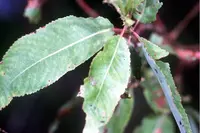
Peachleaf willow, Salix amygdaloides, is a fast-growing deciduous tree native to riverbanks, floodplains, and moist lowlands of North America. It often forms multi-trunked clumps with narrow, lance-shaped leaves that resemble peach leaves.
This species typically grows in full sun along streams, ponds, and wet ditches, helping stabilize soil and provide wildlife habitat. Its flexible branches and rapid growth make it useful in naturalistic plantings, windbreaks, and restoration projects.
For those learning how to care for peachleaf willow, the key traits are its strong preference for constant moisture, tolerance of heavy or sandy soils, and need for ample light, balanced by a relatively short life span and brittle wood.

Care Difficulty
Moderate Care

Light Preference
Full Sun

Water Requirements
Keep Soil Moist

Temperature Preference
Cold Hardy

Hardiness Zone
3–8

Soil Texture
Sandy, Loamy, Silty

Soil pH
Acidic (5.5–6.5), Slightly acidic (6.5–7.0)

Soil Drainage
Waterlogged tolerant

Fertilization
Minimal (feed rarely)
Scan your plant to receive care tips personalized for your specific plant
Available on iOS and Android
This fast-growing riparian tree needs abundant direct light to maintain dense, healthy growth.
This species is adapted to moist riverbanks and prefers consistently damp soil in cultivation.
This hardy North American willow tolerates a wide range of outdoor temperatures across much of the US.
This species prefers moist air but typically adapts well to outdoor humidity ranges of 40–80%.
Salix amygdaloides thrives in consistently moist, deep soils with ample organic matter.
This species can be grown in containers only as a short-term or juvenile specimen due to its vigorous root system.
This fast-growing riparian tree usually needs minimal feeding in open ground but responds to light nutrition on poor sites or in containers.
Pruning helps maintain structure, safety, and vigor in Salix amygdaloides, which tends to form fast, sometimes brittle growth.
This species is rarely kept long-term in containers; most Salix amygdaloides plants are transplanted young into permanent ground positions.
This willow is commonly propagated for restoration plantings and shelterbelts, mainly through hardwood cuttings taken from healthy, vigorous shoots.
Established Salix amygdaloides trees are cold hardy across much of the northern US and usually need little special winter care in the ground.

Plant Health Check
Not sure what's wrong with your plant? Check your plant's health inside the app.
This species is one of the characteristic willows of the northern Great Plains and upper Mississippi River region, where it naturally colonizes sandbars, riverbanks, and floodplains after disturbances such as floods.
It acts as a pioneer tree on bare alluvial sand and gravel, its dense root system helping to trap sediments and stabilize unstable river margins, which prepares the site for later successional tree species like cottonwoods.
Its common name, peachleaf willow, refers to its narrow, finely serrated leaves that resemble those of peach and almond trees more than the broader leaves of many other North American willows.

This willow plays an important role in riparian wildlife habitat, providing early-season nectar and pollen for native bees and other insects, along with nesting and perching sites for songbirds that use its flexible twigs and branch structure along rivers and streams.
This species is considered fast-growing, often adding 60–120 cm of height per year in favorable conditions. Growth is quickest in consistently moist soil, full sun, and where the root zone is not compacted or restricted.
Keep your plants happy and healthy with plant identification, disease detection, and easy care guidance.