Snow cover management
In regions with natural snowfall, allow a stable snow cover to insulate plants over winter, but gently break and remove dense ice crusts in late winter so new shoots are not mechanically damaged as they emerge.

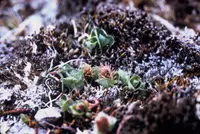
Arctic willow (Salix arctica) is a dwarf shrub adapted to very cold climates, often forming low mats or cushions close to the ground. Its tiny rounded leaves and woody stems help it survive strong winds and short growing seasons. In the wild it occurs across Arctic and subarctic regions, including northern North America and Greenland, often on rocky or tundra soils. This species grows slowly but is tough, making it suitable for rock gardens, troughs, and other exposed, cool sites. It prefers full sun, cool temperatures, moist but well-drained soil, and benefits from shelter from intense heat when you learn how to care for arctic willow.

Care Difficulty
Hard Care

Light Preference
Full Sun

Water Requirements
Regular Water

Temperature Preference
Cold Hardy

Hardiness Zone
1–6

Soil Texture
Sandy, Loamy, Rocky

Soil pH
Strongly acidic (4.5–5.5), Acidic (5.5–6.5)

Soil Drainage
Moist but well-drained

Fertilization
Minimal (feed rarely)
Scan your plant to receive care tips personalized for your specific plant
Available on iOS and Android
This dwarf willow thrives in bright, cool conditions with long daylight but low sun intensity.
This species prefers consistently moist but not stagnant soil, especially during active growth.
This tundra shrub is extremely cold-hardy but grows best in cool, stable temperatures.
Humidity is not a major factor for this cold-adapted shrub, which tolerates wide atmospheric moisture ranges.
Salix arctica prefers mineral, sharply draining, low-fertility substrates that mimic alpine or tundra conditions.
This species can be grown in containers if the setup mimics cold, exposed, well-drained conditions.
This arctic willow stays compact and healthy with very modest feeding in most garden soils.
Pruning Salix arctica is mainly about maintaining structure and removing stressed growth.
This species is usually grown in the ground, so focus on careful site transplanting rather than frequent container repotting.
New plants are most reliably produced from cuttings, with seeds used mainly for larger-scale or experimental growing arctic willow.
This low willow is highly cold hardy and usually needs minimal winter care in outdoor beds.

Plant Health Check
Not sure what's wrong with your plant? Check your plant's health inside the app.
This species is one of the tiniest woody plants on Earth, often growing only 1–6 cm tall while still forming true shrubs with woody stems.
Salix arctica survives in high Arctic habitats where the growing season can be as short as 6–8 weeks, using low, ground-hugging growth to avoid wind chill and benefit from slightly warmer air near the soil.
The species can reproduce both by seed and by creeping stems that root along the ground, which helps it persist and spread in unstable, frost-disturbed soils.

Salix arctica leaves and stems can photosynthesize at very low temperatures close to freezing, allowing the plant to take advantage of brief warm spells and low-angle Arctic sunlight that many other woody species cannot use effectively.
Leaf browning often comes from wind desiccation, salt spray, or extended drought rather than heat. Check for dry, crumbly soil, exposed windy sites, and winter road salt. Mulch lightly, water during dry spells, and improve wind protection.
Keep your plants happy and healthy with plant identification, disease detection, and easy care guidance.