


Russian thistle Identification (Salsola kali)

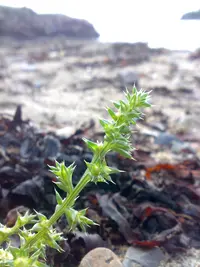
Recognize Russian thistle by its low, much-branched, rounded form, with many stiff stems radiating from the base and narrow, awl-shaped leaves set alternately along the stems.

Small flowers sit singly in the leaf axils, where each is subtended by sharp, spine-tipped bracts that make the branchlets notably prickly.

Salsola kali Identification

Scan to Confirm Russian thistle

Use a clear photo to confirm what plant you have.

Clear images work best. Avoid photos taken too close or too far away

  • 1 free identification
  • No sign-up
  • 30,000+ plants in database

Check the plant’s overall shape, stems, leaves, and tiny flowers.

  • Usually forms a rounded, much-branched plant, often 1 to 3 feet (30 to 90 cm) tall and wide.
  • Branches spread from low on the plant, creating a dense, bushy framework with many slender stems.
  • Leaves are narrow and stiff, about 1 to 2 inches (2.5 to 5 cm) long, ending in a sharp spine-like tip.
  • Small flowers sit singly in the leaf axils, tucked close along the stems rather than in showy clusters.

The spiny leaf tips and rounded, heavily branched form are the fastest checks.

Salsola kali shows clear structural shifts from a soft seedling to a spiny adult.

  • Seedling: Seedlings form a small, upright sprout with narrow, soft, threadlike first leaves and no stiff spines; stems are green and mostly unbranched.
  • Young plant: Young plants branch from the base into a low, bushy outline. Leaves stay slender and fleshy, but the tips begin hardening into short prickles.
  • Mature plant: Mature plants become rounded and densely branched, often 1-3 feet (30-90 cm) across, with rigid, spine-tipped leaves and wiry stems forming a tumbleweed shape.
  • Fruiting stage: At fruiting, small papery wings around each fruit become visible along the stems, giving branchlets a rougher, more fringed look than earlier stages.

In spring and early summer, Russian thistle appears as a low, soft-looking plant with narrow, fleshy leaves. By later summer, the stems branch heavily and the plant becomes more rounded and bushy. Late summer into fall brings small, inconspicuous flowers in the leaf axils, where leaves join the stem. As the season advances, the whole plant often dries, turns straw-colored, and becomes a rigid, prickly skeleton.

A few salt-tolerant annuals can be mistaken for Russian thistle at a glance.

prickly Russian thistle(Salsola tragus)

Often confused because both form rounded, much-branched tumbleweeds with narrow leaves. Salsola tragus usually has softer, threadlike leaves on young growth and broader papery wings around the fruit; Salsola kali has stiffer, more spine-tipped leaves and a coarser, more rigid look.

barbwire Russian thistle(Salsola paulsenii)

This species also makes a dense, spiny, rounded plant. It differs by having stronger paired spines at the nodes and a tighter, more tangled branching pattern, while Salsola kali is typically less paired-spiny and more openly branched.

Salsola kali is native to coastal parts of Europe, Asia, and North Africa. It is closely tied to seashores, especially sandy and shingly beaches, upper shorelines, and coastal dunes. That setting helps with identification. A sprawling, very spiny annual found on open maritime beaches or strandline margins is more likely to be Salsola kali than an inland saltbush or other dry-ground weed. Coastal exposure and saline ground are useful field clues.

  • Sharp spines: The stiff, spine-tipped leaves and bracts can scratch or puncture skin on contact in humans and pets. Dry plants are especially prickly to handle.
  • Ingestion risk: Salsola kali is not mainly known for poisoning, but its hard, spiny stems and leaves can injure the mouth or digestive tract if chewed or swallowed by people or pets.

Check Your Plant ID

Use Botan to compare a photo and help confirm the plant, which can save time before you rely on an identification.

FAQ

Yes. Seedlings have narrow, soft, threadlike leaves. As stems age, later leaves become shorter and stiffer, ending in a sharp point, which is useful when identifying Russian thistle in summer and fall.

More Plant Identification Guides

Identify Your Plant and Learn More

Upload a photo to Botan for identification, then see plant details, care information, and common problems for that species.

Botan app identifying a plant from a photo
How to Increase Humidity for Plants – 8 Simple Ways That Work

8 min read · 14 Aug 2026

How to Increase Humidity for Plants – 8 Simple Ways That Work

Dry indoor air stresses a lot of houseplants. You usually notice it first in the browning leaf tips. This guide describes 8 simple ways to raise the moisture around your plants, from humidifiers to pebble trays.

Plant Care

How to Increase Humidity for Plants – 8 Simple Ways That Work
12 Best Landscaping Trees for Your Garden

8 min read · 6 Oct 2026

12 Best Landscaping Trees for Your Garden

Choosing the landscape tree depends on what your garden needs most. These 12 options include compact flowering specimens, colorful deciduous trees, shade varieties, and evergreens suitable for screening and year-round structure.

Plant Recommendations
12 Best Landscaping Trees for Your Garden
Rice Water for Plants – Which Plants Love It and How to Make It

8 min read · 14 Jul 2026

Rice Water for Plants – Which Plants Love It and How to Make It

Rice water can be an ideal DIY solution for orchids, roses, or fruiting plants. It supports growth, leaf count, and height. We’ll share how to make and apply it correctly for your plant.

Plant Care
Rice Water for Plants – Which Plants Love It and How to Make It