

Edge spill management
Plant slightly back from container rims or bed edges and gently tuck young stems outward so they can trail cleanly without being damaged by foot traffic, mower wheels, or edging tools.

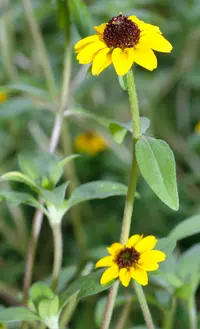
Mexican creeping zinnia, Sanvitalia procumbens, is a low, trailing annual often used as a flowering groundcover or to spill over the edges of containers and baskets. It forms a dense mat of small, dark green leaves dotted with many yellow, daisy-like flowers.
This species is native to Mexico and parts of Central America, where it grows in sunny, open sites. It is generally easy to grow, as it tolerates heat and light drought once established, and flowers over a long season with regular deadheading.
Gardeners who want to care for Mexican creeping zinnia should know it prefers full sun, well-drained soil, and moderate moisture, making it suitable for many garden settings and patio containers.

Care Difficulty
Easy Care

Light Preference
Full Sun

Water Requirements
Moderate Water

Temperature Preference
Tropical / Frost Sensitive

Hardiness Zone
9–11

Soil Texture
Sandy, Loamy, Organic-rich

Soil pH
Acidic (5.5–6.5), Slightly acidic (6.5–7.0)

Soil Drainage
Well-drained

Fertilization
Light (every 4–6 weeks)
Scan your plant to receive care tips personalized for your specific plant
Available on iOS and Android
This sun-loving annual flowers best with strong light and open exposure.
This plant prefers evenly moist, well-drained soil that never stays soggy for long periods.
This warm-season annual thrives in stable, mild to warm conditions without frost exposure.
Humidity is rarely a limiting factor for this drought-tolerant species.
Sanvitalia procumbens prefers light, well-drained soil that never stays waterlogged.
This species is very suitable for container growing, including baskets and shallow bowls.
Sanvitalia procumbens responds well to modest feeding that supports flowering without forcing lush, weak growth.
Pruning helps Sanvitalia procumbens stay compact, dense, and floriferous through the season.
Mexican creeping zinnia is usually grown as a bedding or container annual, so transplanting at the right stage is important for quick establishment.
Sanvitalia procumbens is commonly propagated from seed, with cuttings as a secondary option for clonal plants.
Sanvitalia procumbens is usually grown as a warm-season annual and does not tolerate hard frost.

Plant Health Check
Not sure what's wrong with your plant? Check your plant's health inside the app.
This species has a strongly prostrate, mat-forming growth habit that allows it to spread across soil or over container edges while staying only a few cm tall, which helps suppress small weeds and protect the soil surface from direct sun.
It is naturally adapted to hot, sunny conditions and tends to flower most abundantly in full sun and warm weather, often continuing to bloom when cooler-season ornamentals slow down.
Its flower heads have large, showy central disks and relatively small yellow ray florets, giving each bloom a button-like appearance that distinguishes it from many other daisy relatives with broader petals.

Genetic and morphological studies have supported placing this species in the sunflower family (Asteraceae), closely allied with genera such as Zinnia, which is why it is sometimes marketed under the descriptive common name Mexican creeping zinnia even though it is not a true zinnia.
This species spreads low and wide but is not usually aggressive. It forms a dense mat within its planting area, yet is easy to control by edging, trimming, or lifting unwanted runners by hand.
Keep your plants happy and healthy with plant identification, disease detection, and easy care guidance.

Golden Star
Chrysogonum virginianum var. australe
paleleaf woodland sunflower
Helianthus strumosus

Busy lizzie
Impatiens walleriana
Cruciata taurica
Cruciata taurica

yellow thistle
Cirsium horridulum
spanish lavender
Lavandula pedunculata
red star
Hypoxis baurii
Hibiscus Summerific Cranberry Crush
Hibiscus Summerific Cranberry Crush