Use matching host
Establish the fungus near compatible conifer hosts such as spruce or pine on sites that are not heavily fertilized, since high soil nutrients suppress mycorrhizal formation and reduce fruiting.

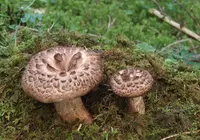
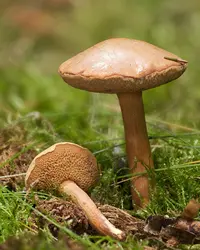
Scaly tooth, Sarcodon imbricatus, is a terrestrial mushroom-forming fungus rather than a leafy plant. It produces thick, brown, layered caps with downward-pointing spines instead of gills, giving it a coarse, scaly look.
This species is typically found in coniferous forests of Europe, North America, and parts of Asia, often in association with pine and spruce trees. It forms mycorrhiza, a nutrient-sharing partnership with tree roots, so it does not adapt well to typical houseplant conditions.
Because it depends on this close tree partnership, it is considered challenging to cultivate artificially. Gardeners who wish to care for Scaly tooth usually focus on supporting suitable host trees and natural woodland-style conditions with moist, well-drained, acidic soil.

Care Difficulty
Hard Care

Light Preference
Partial Shade

Water Requirements
Regular Water

Temperature Preference
Cold Hardy

Hardiness Zone
3–8

Soil Texture
Loamy, Sandy, Organic-rich

Soil pH
Strongly acidic (4.5–5.5), Acidic (5.5–6.5)

Soil Drainage
Moist but well-drained

Fertilization
Minimal (feed rarely)
Scan your plant to receive care tips personalized for your specific plant
Available on iOS and Android
This ectomycorrhizal fungus prefers cool, subdued forest light rather than direct sun.
Moist but not waterlogged soil is essential for healthy mycelium and fruiting body development.
This species favors cool, temperate conditions typical of coniferous forests.
This ectomycorrhizal fungus prefers consistently moist air similar to a conifer forest floor rather than very dry conditions.
This woodland fungus needs a loose, organic, and well-drained yet evenly moist substrate to form mycorrhizae with host trees.
This species is generally unsuitable for conventional container growing because it relies on stable mycorrhizal partnership with living trees in a broader soil environment.
Sarcodon imbricatus is a mycorrhizal fungus that relies on its tree partner, so extra fertilizer is usually unnecessary and can be harmful.
Pruning Sarcodon imbricatus is not part of normal care, as fruiting bodies are seasonal and short-lived.
This fungus is not suited to typical repotting and is best managed by careful transplanting of its forest habitat or host seedlings.
Propagation of Sarcodon imbricatus is technically complex and not usually attempted by home growers.
Scaly tooth is naturally cold hardy in temperate forests and generally needs no special winter care when left in situ.

Plant Health Check
Not sure what's wrong with your plant? Check your plant's health inside the app.
The fruiting body forms a large, brown, tile-like cap whose underside is lined with downward-pointing spines or “teeth” instead of gills or pores, a hallmark of the tooth fungi group. These teeth release spores, which fall from the tips and disperse on air currents near the forest floor.
This species forms ectomycorrhizal associations with the roots of conifers such as spruce and pine, exchanging mineral nutrients and water for sugars from the tree. Its presence often indicates relatively undisturbed, mature coniferous forests with acidic soils.
In some European regions the mushroom is consumed when young, while in others it is considered too bitter or is avoided due to confusion with similar species. Its taste and bitterness seem to vary with age, habitat, and possibly local fungal strains.

This fungus has been traditionally used in parts of Scandinavia and Central Europe as a natural dye source, producing blue-gray to greenish hues on wool when combined with different mordants in the dyeing process.
The fruiting body is technically edible but often very bitter and tough, especially in older specimens. Some foragers parboil and discard the water to reduce bitterness. Only eat correctly identified, fresh, and uncontaminated mushrooms.
Keep your plants happy and healthy with plant identification, disease detection, and easy care guidance.