Contain Rhizome Spread
Install a 20–30 cm deep root barrier or plant in a large submerged container if grown in a pond or bog garden to keep the rhizomes from invading nearby planting areas while still allowing a dense colony to form.

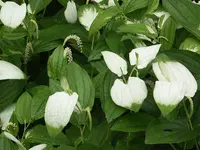
Asian lizard's tail (Saururus chinensis) is a moisture-loving, herbaceous perennial often found along streams, pond edges, and wetlands in East Asia. It forms leafy clumps with upright stems and distinct, tail-like flower spikes that give the plant its common name.
In gardens, it is usually grown in shallow water or very damp soil, where it can spread to make a dense, low colony. It prefers full sun to partial shade and consistently wet, humus-rich soil.
Gardeners who want to learn how to care for Asian Lizard's Tail usually find it manageable if given enough moisture and space to spread, but it can be vigorous in ideal conditions.

Care Difficulty
Moderate Care

Light Preference
Partial Shade

Water Requirements
Aquatic

Temperature Preference
Cold Hardy

Hardiness Zone
4–8

Soil Texture
Loamy, Clay, Organic-rich

Soil pH
Acidic (5.5–6.5), Slightly acidic (6.5–7.0)

Soil Drainage
Waterlogged tolerant

Fertilization
Minimal (feed rarely)
Scan your plant to receive care tips personalized for your specific plant
Available on iOS and Android
This wetland perennial prefers bright conditions but not intense, drying sun.
This species naturally grows in saturated soils and shallow water, so moisture levels must stay consistently high.
This marginal aquatic plant prefers moderate warmth but survives a wide range of outdoor temperatures.
This wetland species prefers high humidity and struggles in dry indoor air.
Soil for Saururus chinensis should stay consistently wet yet still contain some air spaces around the roots.
This species can be grown in containers if the pot is managed like a mini-bog.
Saururus chinensis responds well to light feeding in nutrient-poor soils but often grows acceptably in rich, natural ground without extra fertilizer.
Pruning Saururus chinensis is straightforward and mainly keeps the clump tidy and within bounds.
This plant is usually grown in the ground, so focus on dividing and transplanting mature clumps rather than frequent repotting.
Saururus chinensis is commonly propagated by division, with seeds or rhizome cuttings used less often in home gardens.
This hardy perennial usually needs minimal winter attention in most temperate climates.

Plant Health Check
Not sure what's wrong with your plant? Check your plant's health inside the app.
During flowering, the upper part of some leaves turns white, a temporary color change that helps attract pollinators to the otherwise small, petal-less flowers.
Its rhizomes release a distinct peppery or spicy scent when crushed, which is reflected in common names such as Asian lizard’s tail and hossuyuko in Japan.
This species naturally grows in shallow water, marshes, and along stream margins across East Asia, forming dense colonies through creeping rhizomes in consistently wet soils.

In parts of East Asia, especially Korea and Japan, young leaves and shoots of Saururus chinensis have been traditionally used as a wild vegetable and flavoring herb, giving it both ecological and culinary significance in local wetland landscapes.
This species spreads by creeping rhizomes and can form dense colonies in consistently moist or shallow-water sites. In small gardens or ponds, use barriers, containers, or regular division to prevent unwanted spread and keep it contained.
Keep your plants happy and healthy with plant identification, disease detection, and easy care guidance.