Mark Dormant Clumps
After foliage dies back in late spring, mark bulb locations with discreet labels or stones so you avoid disturbing dormant bulbs during summer weeding or soil work.

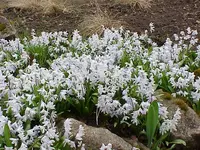
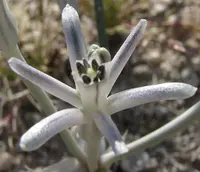
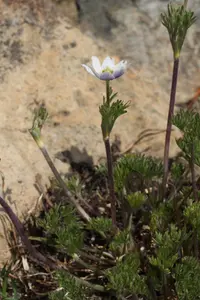
Mishchenko squill, Scilla mischtschenkoana, is a small bulbous perennial grown mainly for its very early spring flowers. It produces low rosettes of narrow gray-green leaves and short stems topped with pale icy-blue, star-shaped blooms.
This species comes from rocky slopes and open woodland edges in the Caucasus region and northern Iran, where it copes with cold winters and dry summers. It is generally easy to grow in gardens, naturalized lawns, or rock gardens, and works best in well-drained soil with moderate moisture and sun to light shade.
Because it is hardy, long-lived, and spreads slowly by seed and offsets, it suits beginners learning how to care for Mishchenko squill.

Care Difficulty
Easy Care

Light Preference
Partial Sun

Water Requirements
Moderate Water

Temperature Preference
Cold Hardy

Hardiness Zone
4–8

Soil Texture
Sandy, Loamy, Organic-rich

Soil pH
Acidic (5.5–6.5), Slightly acidic (6.5–7.0)

Soil Drainage
Well-drained

Fertilization
Minimal (feed rarely)
Scan your plant to receive care tips personalized for your specific plant
Available on iOS and Android
This early spring bulb prefers bright, cool conditions with some sun each day.
This bulb prefers steadily moist but not saturated soil during its short active season.
This hardy bulb thrives in cool spring temperatures and tolerates substantial winter cold.
This bulb tolerates typical household humidity and does not need special humidity management.
Scilla mischtschenkoana prefers loose, moisture-retentive but free-draining soil that never stays waterlogged.
This small bulb is well suited to container growing outdoors.
This small bulb needs only light feeding to maintain flowering and foliage health.
Scilla mischtschenkoana requires only minimal pruning, mainly for cleanliness and bulb health.
This bulb is usually grown in the ground, so focus on dividing and transplanting crowded clumps rather than frequent repotting.
This bulb is commonly propagated by division, with seed raising used less often for home gardens.
This hardy spring bulb needs little winter care in most temperate climates.

Plant Health Check
Not sure what's wrong with your plant? Check your plant's health inside the app.
This species often flowers in very late winter or early spring, sometimes pushing through melting snow, because its floral development is triggered by soil temperature and daylength rather than consistent mild air temperatures.
It is native to the South Caucasus region (notably parts of Armenia, Azerbaijan, and northern Iran), where it grows in open, rocky slopes and sparse woodlands that experience cold winters and dry summers.
The flowers are a very pale blue to nearly white with a faint central blue stripe on each tepal, a pattern that helps guide early pollinators such as bees to the nectar source.

The species was formally described only in the mid 20th century, and its specific epithet mischtschenkoana honors Russian botanist Pavel M. Mischtschenko, recognizing his contributions to documenting the flora of the Caucasus region.
This bulb forms small clumps and slowly multiplies by offsets and self-seeding. It usually stays well behaved in typical garden settings, spreading into gentle drifts rather than forming dense, smothering carpets.
Keep your plants happy and healthy with plant identification, disease detection, and easy care guidance.