Contain Spreading Roots
Install a shallow root barrier or plant in a dedicated bed or large sunken container if soil is consistently moist, as this species can slowly spread by rhizomes and crowd nearby smaller plants over several seasons.

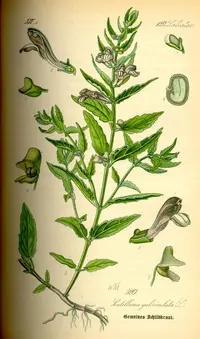
Common scullcap (Scutellaria galericulata) is a small, clump-forming perennial herb in the mint family, grown mainly for its delicate blue to violet flowers. It typically forms upright, branched stems with narrow, opposite leaves and pairs of hooded blooms that attract bees and other small pollinators.
This species naturally occurs in wetlands, stream edges, and damp meadows across cooler regions of Europe, Asia, and North America. It generally prefers consistently moist soil and light ranging from full sun in cooler climates to partial shade in warmer areas.
For gardeners, it is moderately easy to grow if moisture is reliable and soil does not dry out for long periods. This makes it useful for learning how to care for common scullcap in rain gardens, pond margins, or other damp sites.

Care Difficulty
Moderate Care

Light Preference
Partial Sun

Water Requirements
Aquatic

Temperature Preference
Cold Hardy

Hardiness Zone
3–8

Soil Texture
Loamy, Silty, Organic-rich

Soil pH
Acidic (5.5–6.5), Slightly acidic (6.5–7.0)

Soil Drainage
Waterlogged tolerant

Fertilization
Minimal (feed rarely)
Scan your plant to receive care tips personalized for your specific plant
Available on iOS and Android
This moisture-loving perennial prefers bright conditions without prolonged harsh sun.
This species naturally grows in wet meadows and stream edges, so it prefers consistently moist soil.
This hardy species tolerates cool climates but grows best in mild, moist conditions.
This wetland perennial prefers consistently high humidity close to saturated air.
This species prefers permanently moist, organic-rich soil that mimics a pond margin or marsh edge.
This species can be grown in containers if the setup reliably keeps the root zone wet.
This moisture-loving native perennial needs only modest feeding to stay healthy in garden or container settings.
Pruning Scutellaria galericulata is simple and mainly helps keep plants tidy and flowering well.
This species is more often transplanted in the garden than grown long term in containers.
Scutellaria galericulata is commonly propagated by seed and by careful division of established clumps.
This cold-hardy perennial usually needs minimal winter attention in typical temperate climates.

Plant Health Check
Not sure what's wrong with your plant? Check your plant's health inside the app.
This species often grows at the very edge of water bodies, and its root system tolerates low-oxygen, waterlogged soils better than many other mint family members, allowing it to stabilize muddy banks and shallow margins.
The two-lipped blue flowers have an arched upper lip that forms a cap or hood, which inspired the name galericulata, meaning ‘hooded’ in Latin, and helps guide specific bee pollinators to the nectar.
This species occurs across much of the cool-temperate Northern Hemisphere, including North America and Europe, where it is typically found in marshes, ditches, fen edges, and slow stream margins rather than in dry upland habitats.

The small, cup-like calyx of each faded flower develops a rigid, turtlehead-shaped structure that can persist after flowering and is used by botanists as a key character to distinguish this species from closely related skullcaps in wetland surveys.
This species is valuable for pollinators. The tubular blue flowers provide nectar for bees, hoverflies, and some butterflies, especially near wetlands and ponds. Avoid using insecticides nearby to maintain a healthy pollinator population.
Keep your plants happy and healthy with plant identification, disease detection, and easy care guidance.