


Sun-Stress Coloring
Gradually move the plant to slightly brighter, cooler conditions in late spring to encourage red pigmentation on the leaves without burning, watching for any pale or crispy tips as a sign to pull it back a little.

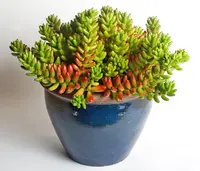
Christmas-cheer (Sedum × rubrotinctum) is a small, low-growing succulent valued for its plump, jelly bean–shaped leaves and compact, spreading habit. The foliage often shifts from green to red tones when exposed to bright light.
This plant originates from hybrid Sedum parents with roots in Mexico, so it is adapted to dry, sunny conditions and lean, well-drained soils. Its slow, tidy growth and strong drought tolerance make it suitable for containers, rock gardens, and indoor sunny windowsills.
For those learning how to care for Christmas-cheer, it is considered an easy, beginner-friendly plant as long as it receives strong light, minimal excess moisture, and avoids prolonged frost.

Care Difficulty
Easy Care

Light Preference
Full Sun

Water Requirements
Low Water

Temperature Preference
Tropical / Frost Sensitive

Hardiness Zone
10–11

Soil Texture
Sandy, Loamy, Rocky

Soil pH
Slightly acidic (6.5–7.0), Neutral (7.0)

Soil Drainage
Well-drained

Fertilization
Minimal (feed rarely)
Scan your plant to receive care tips personalized for your specific plant
Available on iOS and Android
This succulent needs bright light to develop compact growth and strong red coloration.
Watering should be infrequent and guided by soil dryness rather than a fixed schedule.
Stable warmth supports dense growth and helps maintain leaf color.
This succulent handles typical indoor humidity well, so moisture in the air is rarely a problem.
This plant needs sharply draining, mineral-based soil to prevent root rot and maintain compact growth.
This species is very suitable for small containers and dish gardens.
This succulent needs only light feeding, as Christmas-cheer stores nutrients efficiently in its leaves and roots.
Pruning Sedum × rubrotinctum is mainly for shaping and removing unsightly growth.
This plant prefers slightly snug containers and does not require frequent repotting.
Multiplying this succulent is straightforward and commonly done from stem and leaf cuttings.
This succulent is frost-sensitive and benefits from simple winter precautions in most climates.

Plant Health Check
Not sure what's wrong with your plant? Check your plant's health inside the app.
The leaves redden under high light and cooler temperatures because they accumulate anthocyanins, protective pigments that help shield the tissues from excess sunlight and oxidative stress.
Individual leaves can detach, callus, and grow roots and shoots from meristematic cells along the leaf base, which makes this species extremely efficient at vegetative propagation.
This plant is a horticultural hybrid in the Crassulaceae family whose exact wild parents are not firmly established, and it is mainly known from cultivation rather than from natural habitats.

Like other members of Crassulaceae, this species uses crassulacean acid metabolism (CAM), a photosynthetic pathway in which stomata open mostly at night to reduce water loss in arid or seasonally dry conditions.
Brown leaves usually result from intense sun scorch, prolonged drought, or salt buildup from fertilizer. Check for dry, crispy tips, hard compacted soil, or white crust on the surface and adjust watering and fertilizing gradually.
Keep your plants happy and healthy with plant identification, disease detection, and easy care guidance.

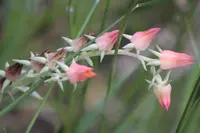
Echeveria erubescens
Echeveria erubescens
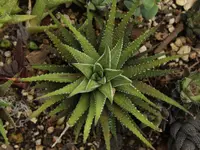
Fasciated haworthia
Haworthiopsis fasciata
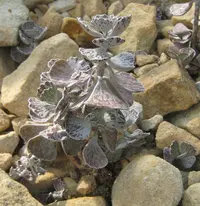
Pies from Heaven
Kalanchoe rhombopilosa
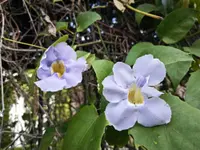
Blue sky vine
Thunbergia grandiflora
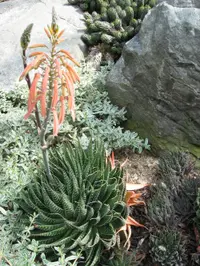
Lace aloe
Aristaloe aristata
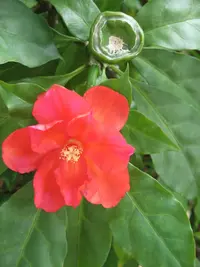
Rose Cactus
Leuenbergeria bleo
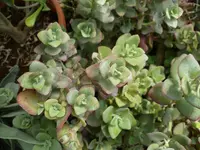
Heart-leaved Crassula
Crassula cordata

Speedy Jenny
Tradescantia chrysophylla 'Baby Bunny Bellies'