Shallow dish setup
Grow this plant in a wide, shallow container lined with sphagnum moss or fine grit so its creeping stems can root along the surface and form an even, dense mat.

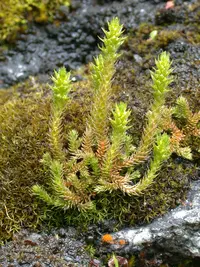
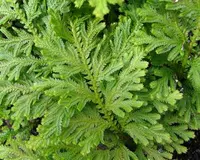
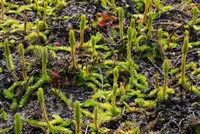
Selaginella selaginoides, commonly called club spikemoss, is a small, ancient spore-bearing plant related to ferns, not a true moss. It forms low, tufted mats of fine, scale-like leaves on thin, creeping stems.
In nature it grows in cool, wet habitats such as bogs, stream edges, and damp alpine meadows across parts of Europe, Asia, and North America. It prefers consistently moist conditions and does not tolerate drying out, which makes it more demanding than many typical houseplants.
For those who want to learn how to care for Club Spikemoss, it suits humid, shaded spots with soft, steadily moist soil and good air circulation.

Care Difficulty
Hard Care

Light Preference
Partial Shade

Water Requirements
Keep Soil Moist

Temperature Preference
Cold Hardy

Hardiness Zone
2–7

Soil Texture
Loamy, Peaty, Organic-rich

Soil pH
Strongly acidic (4.5–5.5), Acidic (5.5–6.5)

Soil Drainage
Moist but well-drained

Fertilization
Minimal (feed rarely)
Scan your plant to receive care tips personalized for your specific plant
Available on iOS and Android
This alpine clubmoss prefers cool, soft light rather than strong direct sun.
This species needs consistently moist conditions but suffers in stagnant, waterlogged soil.
This plant prefers cool to mild temperatures and does poorly in strong heat or deep frost.
This moisture-loving species needs consistently high air humidity to stay dense and green.
Selaginella selaginoides prefers consistently moist, airy, organic-rich soil that never becomes waterlogged.
This low, mat-forming species adapts well to shallow containers and terrariums.
Selaginella selaginoides needs only light feeding, especially when grown in low-nutrient, moist conditions similar to its natural habitats.
Pruning needs for Selaginella selaginoides are minimal and mostly cosmetic.
This species is more often transplanted in the garden than repotted, since it forms low, shallow-rooted mats.
Propagation of Selaginella selaginoides is possible but slower than in many common houseplants.
This species is cold hardy in many temperate climates and usually needs only modest winter care.

Plant Health Check
Not sure what's wrong with your plant? Check your plant's health inside the app.
This species looks like a tiny clubmoss, but it is actually a spikemoss and not a true moss or lycophyte clubmoss, despite the similar low, creeping habit and cone‑like fertile spikes.
It has a distinctly northern and upland distribution, occurring mainly in subarctic, arctic, and high‑altitude bogs and wet heaths, where it tolerates cold, short growing seasons and waterlogged, acidic substrates.
Like other lycophytes, it reproduces by spores rather than seeds; its strobili (spore cones) produce two different types of spores, a condition known as heterospory, which represents an important step in the evolution of seed plants.

Pollen records show that this species was present in parts of Europe soon after the last glaciation, making it a useful indicator in paleoecological studies for tracking the retreat of ice and the early development of cold, wet postglacial habitats.
This species does not climb. It forms low, creeping mats with short, branching stems that root as they contact suitable substrate. Over time, it slowly spreads outward, creating a dense, moss-like carpet rather than vertical growth.
Keep your plants happy and healthy with plant identification, disease detection, and easy care guidance.