Provide sturdy supports
Install short, sturdy stakes or low wire hoops early in the season so mature stems stay upright in wind and heavy rain without snapping at the base.

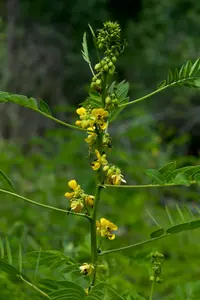
Maryland senna (Senna marilandica) is a hardy, clump-forming perennial native to prairies, open woods, and stream edges in eastern and central North America. It belongs to the legume family and often grows in loose colonies.
The plant has upright stems with pinnate, medium-green leaves and bright yellow summer flowers, followed by decorative, bean-like seed pods. Its strong vertical habit and generous flowering make it useful in naturalistic borders, pollinator gardens, and restoration plantings.
Maryland senna prefers full sun, moist but well-drained soil, and tolerates clay once established. Deep roots and good stress tolerance make it relatively straightforward for gardeners who want to learn how to care for Maryland senna.

Care Difficulty
Easy Care

Light Preference
Full Sun

Water Requirements
Moderate Water

Temperature Preference
Cold Hardy

Hardiness Zone
4–9

Soil Texture
Sandy, Loamy, Clay

Soil pH
Acidic (5.5–6.5), Slightly acidic (6.5–7.0)

Soil Drainage
Moist but well-drained

Fertilization
Minimal (feed rarely)
Scan your plant to receive care tips personalized for your specific plant
Available on iOS and Android
This sun-loving perennial thrives in open sites with strong light for best flowering.
This deep-rooted native prefers consistent moisture in its first years, then handles short dry spells.
This hardy perennial is adapted to temperate climates with warm summers and cold winters.
This species is adapted to outdoor conditions and has low sensitivity to air humidity.
This perennial shrub prefers moderately moist, well-drained mineral soils that do not stay waterlogged.
This species can be grown in containers, but large, deep pots are needed to support its size and root system.
This native legume usually needs minimal feeding in average garden soil.
Pruning Senna marilandica is mainly about cleanup and maintaining a strong, open structure.
This species is usually grown in the ground, so care focuses on thoughtful transplanting rather than frequent repotting.
Senna marilandica is most commonly propagated from seeds with some attention to dormancy-breaking steps.
This hardy perennial usually needs little winter attention in its outdoor planting zones.

Plant Health Check
Not sure what's wrong with your plant? Check your plant's health inside the app.
The cloudless sulfur butterfly (Phoebis sennae) relies heavily on this species as a larval host plant in much of its range, and the caterpillars feed almost exclusively on its foliage in some habitats.
This species is naturally associated with open, sunny habitats such as moist prairies, stream banks, and woodland edges in the central and eastern United States, and often persists where these semi-natural habitats are restored.
Like many legumes, this plant forms root nodules with nitrogen-fixing bacteria, which convert atmospheric nitrogen into forms usable by plants and can modestly enrich the surrounding soil over time.

This species is a larval host for certain sulfur butterflies while also producing leaves that many mammal herbivores avoid, creating a selective refuge that can help sustain local butterfly populations in otherwise heavily browsed landscapes.
Poor flowering often comes from too much shade, nutrient-rich soil with excess nitrogen, or plants that are still immature. Ensure full sun, avoid heavy fertilizing, and allow a couple of seasons for strong flower production to develop.
Keep your plants happy and healthy with plant identification, disease detection, and easy care guidance.