Use sacrificial wood
Provide fresh, untreated conifer or hardwood blocks or planks as a sacrificial substrate so the fungus can colonize those instead of nearby structural timber or valuable woodwork.

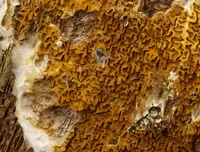
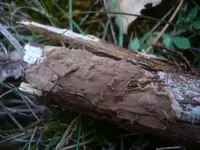
Serpula himantioides is not a typical houseplant but a wood-decaying fungus that forms thin, net-like, orange to reddish-brown crusts on dead conifer wood. It spreads across timber surfaces in irregular patches, often with cord-like strands that penetrate and break down wood structure.
This species occurs mainly in temperate forests of the Northern Hemisphere and is sometimes found on processed timber, such as construction wood. Its growth depends strongly on consistently damp conditions and suitable woody material, which makes it unsuitable for most indoor cultivation.
For anyone trying to care for Serpula himantioides in a research or specialty setting, stable moisture, ample dead conifer wood, and cool, shaded conditions are key requirements.

Care Difficulty
Hard Care

Light Preference
Partial Shade

Water Requirements
Keep Soil Moist

Temperature Preference
Cool Climate

Hardiness Zone
Unknown

Soil Texture
Loamy, Organic-rich, Peaty

Soil pH
Acidic (5.5–6.5)

Soil Drainage
Moist but well-drained

Fertilization
Minimal (feed rarely)
Scan your plant to receive care tips personalized for your specific plant
Available on iOS and Android
This wood-decay fungus prefers low, indirect light that mimics a shaded forest floor.
Moist, well-aerated wood or woody debris is essential for stable development of this fungus.
This species favors cool to mild conditions typical of shaded forest habitats.
This wood-decay fungus is not suitable for typical indoor cultivation and has no practical household humidity guidelines.
Serpula himantioides is a wood-decay fungus that does not grow in horticultural potting mixes, so standard soil preparation is not applicable.
This species is not suitable for container growing, as it is a wood-decay fungus rather than a root-forming plant.
This fungus is adapted to nutrient-poor wood and generally does not need supplemental feeding in cultivation.
Pruning has no role in routine management of Serpula himantioides, since it develops naturally on wood substrates.
When cultivated, this wood-decay fungus is usually managed by renewing its substrate rather than true repotting.
Propagation of Serpula himantioides is usually done by transferring colonized wood rather than by home spore work.
Outdoors on natural wood, this fungus is generally cold tolerant and needs little specific winter care.

Plant Health Check
Not sure what's wrong with your plant? Check your plant's health inside the app.
This fungus is a brown rot species that mainly decomposes conifer wood, breaking down cellulose and hemicellulose while leaving modified lignin behind, which changes the wood to a crumbly, reddish-brown texture.
It occurs across boreal and temperate forests of the Northern Hemisphere, especially in spruce and pine stands, and plays a major role in carbon cycling by rapidly decaying fallen logs and stumps.
Its mycelium can spread extensively within timber, including sawn wood and construction lumber, which is why it is sometimes reported as a cause of structural decay in outdoor wooden elements exposed to moisture.

Molecular studies have shown that specimens once treated as several different brown rot crusts across Europe and North America actually belong to a single, highly variable species, which led to older names such as Serpula pinastri being synonymized under Serpula himantioides.
This crust fungus spreads across wood surfaces relatively quickly but remains confined to decaying timber. It does not invade soil or living plants, yet in damp buildings it can extend widely through contiguous wood and structural materials.
Keep your plants happy and healthy with plant identification, disease detection, and easy care guidance.