Support tall stems
In windy or exposed sites, insert discreet 30–45 cm bamboo canes and loosely tie the main flowering stems to prevent lodging and stem breakage as the umbels become top-heavy.

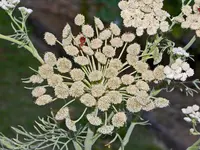
Moon carrot, Seseli gummiferum, is a perennial umbel-forming plant in the carrot family, valued for its fine, bluish foliage and pale dome-shaped flower heads. It forms a low, architectural mound topped by branched stems that carry flat-topped umbels, giving a soft, airy look in mixed borders or gravel gardens.
In nature it occurs in rocky, coastal areas of southeastern Europe and western Asia, which explains its preference for sun, good drainage, and relatively dry conditions. Once established, it is generally undemanding, so gardeners usually find it straightforward to care for moon carrot in suitable climates.

Care Difficulty
Moderate Care

Light Preference
Full Sun

Water Requirements
Low Water

Temperature Preference
Cold Hardy

Hardiness Zone
5–8

Soil Texture
Sandy, Loamy, Rocky

Soil pH
Slightly acidic (6.5–7.0), Slightly alkaline (7.0–7.5)

Soil Drainage
Well-drained

Fertilization
Minimal (feed rarely)
Scan your plant to receive care tips personalized for your specific plant
Available on iOS and Android
Seseli gummiferum grows best in bright, open conditions with plenty of direct sun.
Seseli gummiferum prefers slightly dry, well-drained soil and reacts poorly to standing moisture.
This plant is naturally adapted to cooler, coastal-type climates and copes well with outdoor temperature variation.
Seseli gummiferum handles a wide humidity range and usually does not need special humidity control.
Seseli gummiferum prefers mineral, well-drained soil that mimics dry, rocky coastal slopes.
This species can be grown in containers if the pot is prepared to suit its deep, drought-tolerant root system.
Seseli gummiferum usually grows well in lean soil and needs only light feeding for best performance.
Pruning Seseli gummiferum is minimal and mainly helps keep the plant tidy and focused on healthy flowering.
Moon carrot is usually grown in open ground; transplanting young plants carefully is more important than frequent repotting.
Propagation of Seseli gummiferum is most reliable from seed under cool, bright conditions.
Seseli gummiferum is generally cold hardy in temperate climates and needs little special winter care in the ground.

Plant Health Check
Not sure what's wrong with your plant? Check your plant's health inside the app.
This species naturally occurs on dry, rocky sea cliffs and coastal slopes in the eastern Mediterranean, tolerating salty winds and thin, calcareous soils that many other umbellifers cannot handle.
It forms a basal rosette and usually flowers in its second or third year, producing large, dome-shaped umbels of tiny white flowers that often cause the plant to decline and die back after seed set, behaving almost like a monocarpic (once-flowering) species.
The blue-gray leaves are covered in a waxy bloom called epicuticular wax, which helps reduce water loss and reflects strong sunlight in its exposed coastal habitats.

This species is considered highly attractive to a wide range of pollinators, especially bees, hoverflies, and other beneficial insects, and is sometimes recommended in European biodiversity plantings near coasts because its broad, flat umbels offer an easily accessible nectar and pollen source over an extended flowering period.
Flowering often fails when plants are too young, overcrowded, or growing in overly rich, nitrogen-heavy soil. Allow enough space, avoid frequent fertilizing, and ensure full sun exposure to support reliable umbel formation and seed set.
Keep your plants happy and healthy with plant identification, disease detection, and easy care guidance.