Encourage Spreading
Pinch back the ends of fast-growing stems several times during the warm season to encourage denser lateral branching and a thicker groundcover mat instead of a few long, straggly shoots.

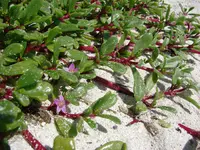
Sesuvium portulacastrum, also known as Sesuvium revolutifolium, is a low, spreading succulent commonly called shoreline seapurslane. It forms dense mats with fleshy leaves and small pink to purple flowers.
This plant naturally occurs in coastal areas, salt marshes, and sandy shores, where it tolerates salt spray and occasional flooding. Its strong salt and drought tolerance make it a resilient option for challenging, sunny sites.
Soils that drain well and full sun exposure usually suit it best. These traits mean it is generally easy to care for Sesuvium portulacastrum in warm, coastal or dry landscapes.

Care Difficulty
Easy Care

Light Preference
Full Sun

Water Requirements
Low Water

Temperature Preference
Warm Climate

Hardiness Zone
8–11

Soil Texture
Sandy, Loamy, Rocky

Soil pH
Slightly acidic (6.5–7.0), Slightly alkaline (7.0–7.5)

Soil Drainage
Waterlogged tolerant

Fertilization
Minimal (feed rarely)
Scan your plant to receive care tips personalized for your specific plant
Available on iOS and Android
Sesuvium revolutifolium thrives in strong light similar to coastal habitats, with many needs shared with Sesuvium portulacastrum.
Sesuvium revolutifolium is a drought-tolerant coastal succulent that prefers infrequent, deep watering.
This species prefers warm conditions and tolerates heat far better than cold.
This coastal succulent handles low ambient humidity and rarely needs special humidity control.
This species prefers very fast-draining, sandy soil that does not stay wet after irrigation or rain.
This low, spreading halophyte can be grown successfully in containers outdoors.
This coastal succulent needs only light feeding in normal garden soils, similar to Sesuvium portulacastrum in low-nutrient habitats.
Sesuvium revolutifolium responds well to light, periodic pruning to control spread and maintain a dense mat.
This species is more often transplanted in the landscape than repotted, as it forms a spreading, shallow-rooted mat.
Sesuvium revolutifolium is commonly propagated from stem cuttings and divisions to expand groundcover patches.
This plant is moderately cold tolerant in mild coastal climates and usually needs minimal winter care.

Plant Health Check
Not sure what's wrong with your plant? Check your plant's health inside the app.
This species naturally colonizes shifting coastal sand dunes in the southeastern United States, where its low, sprawling stems help trap wind‑blown sand and reduce erosion along fragile shorelines.
The plant thrives in upper salt marsh and beach habitats regularly exposed to salt spray and occasional tidal flooding, an indication of its strong physiological tolerance to saline conditions compared with many other coastal herbs.
It is native to the Atlantic and Gulf coasts of the United States, where it occupies a narrow ecological niche along sandy and shelly beaches, back‑dune flats, and disturbed coastal edges rather than inland habitats.
This species forms a low, fast-spreading mat through trailing stems and rooting nodes. In warm, coastal climates it can cover open soil quickly, so it is best used where strong ground-covering growth is desirable and space is available.
Keep your plants happy and healthy with plant identification, disease detection, and easy care guidance.