Install sturdy support
Provide a strong trellis, wire fence, or taut cable system early on, as the vine uses tendrils that twist around thin structures and can deform or collapse weak supports over time.

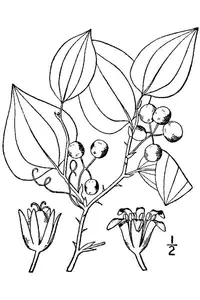
Roundleaf greenbrier (Smilax rotundifolia) is a woody, perennial vine known for its rounded, glossy leaves and sharp, stiff thorns along twining stems. It often forms dense thickets that can climb over shrubs, fences, and small trees.
This species is native to eastern North America, where it grows in woodlands, hedgerows, and disturbed sites with moderate to high moisture. Birds eat its dark berries and help spread the plant, which can make it persistent once established.
It is generally tough and adaptable, but its vigorous, thorny growth can be challenging to manage in small gardens. Understanding how to care for roundleaf greenbrier starts with choosing a suitable site and allowing space for its natural climbing habit.

Care Difficulty
Easy Care

Light Preference
Partial Shade

Water Requirements
Moderate Water

Temperature Preference
Cold Hardy

Hardiness Zone
4–9

Soil Texture
Sandy, Loamy, Clay

Soil pH
Acidic (5.5–6.5), Slightly acidic (6.5–7.0)

Soil Drainage
Moist but well-drained

Fertilization
Minimal (feed rarely)
Scan your plant to receive care tips personalized for your specific plant
Available on iOS and Android
This thorny woodland vine grows best in conditions that mimic bright forest edges with mixed sun and shade.
This species prefers steadily moist, well-drained soil rather than constant saturation or extended drought.
This hardy vine tolerates a wide temperature range typical of much of eastern North America.
This species tolerates a wide humidity range and usually does not need special humidity control.
This vine prefers loose, moist but well-drained soil with moderate organic matter.
This species can be grown in containers if the pot is large, stable, and allows for climbing support.
This vigorous native vine usually grows well without fertilizer, but light feeding can support growth in poor soils when caring for roundleaf greenbrier.
Smilax rotundifolia responds well to controlled pruning to manage size and density.
This vine is usually grown in the ground, so focus on careful transplanting rather than frequent repotting.
Smilax rotundifolia is most reliably propagated by division or digging rhizome sections, with seeds as a slower option.
This species is cold hardy in much of its native range and usually needs minimal winter care outdoors.

Plant Health Check
Not sure what's wrong with your plant? Check your plant's health inside the app.
This species spreads by underground rhizomes and can form dense, long-lived thickets that dominate forest edges and disturbed sites in eastern North America.
It produces thin, broad leaves on its climbing stems for maximum light capture, while tougher, often smaller basal leaves persist near the ground and help the plant survive herbivory and seasonal stress.
Its black, globose berries ripen in late summer to winter and are an important food source for many birds, which disperse the seeds across large areas.

The sharp, recurved prickles on this vine are strong enough to hook into clothing and animal fur, and those same hooked prickles allow the plant to climb through shrubs and small trees without using tendrils or twining stems.
This species spreads vigorously through underground rhizomes and bird-dispersed seeds. In garden settings it can form dense thickets, so use root barriers, regular pruning, or confined beds if you want more controlled growth when trying to grow Smilax rotundifolia.
Keep your plants happy and healthy with plant identification, disease detection, and easy care guidance.