Stilt root support
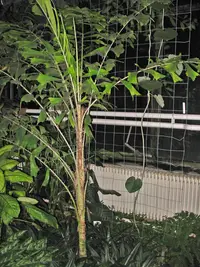
In containers or young landscape specimens, gently mound a coarse, well-drained mix 5–10 cm up around emerging stilt roots to stabilize the plant and encourage stronger additional root formation.

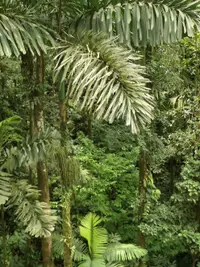
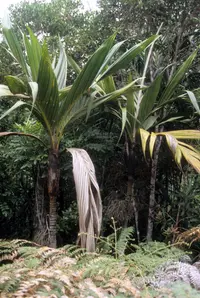
The walking palm, Socratea exorrhiza, is a tropical palm tree native to lowland rainforests of Central and South America. It is known for its unusual stilt roots that lift the trunk above the ground. These roots give the impression that the palm can “walk” slowly by replacing older roots with new ones in better-lit spots. The slender trunk and narrow crown make it look elegant and very vertical. This species is adapted to warm, humid, shaded forest conditions, which makes it difficult to grow indoors or in cooler, drier climates. Those interested in how to care for Walking Palm should know it prefers consistently moist, well-drained soil and protection from strong, direct sun and wind.

Care Difficulty
Hard Care

Light Preference
Partial Shade

Water Requirements
Keep Soil Moist

Temperature Preference
Tropical / Frost Sensitive

Hardiness Zone
11–12

Soil Texture
Loamy, Silty, Organic-rich

Soil pH
Strongly acidic (4.5–5.5), Acidic (5.5–6.5)

Soil Drainage
Moist but well-drained

Fertilization
Minimal (feed rarely)
Scan your plant to receive care tips personalized for your specific plant
Available on iOS and Android
This understory palm prefers bright, filtered light similar to dappled rainforest conditions.
This species prefers consistently moist but not waterlogged soil around its surface roots and stilt roots.
This tropical palm thrives in stable warm conditions with no exposure to frost.
This species needs consistently high humidity to perform well in cultivation.
Socratea exorrhiza requires loose, moist, sharply draining, organic-rich substrate that still holds consistent moisture.
This palm is technically growable in containers but becomes challenging as it gains height and mass.
In cultivation, Socratea exorrhiza benefits from light, consistent nutrition rather than heavy feeding.
Pruning Socratea exorrhiza is mainly hygienic, keeping the palm tidy and safe.
This palm is usually grown in the ground, so focus on careful transplanting rather than frequent repotting.
Propagation of Socratea exorrhiza is specialized and mostly done from seed under controlled conditions.
This strictly tropical palm has no frost tolerance and needs strong winter protection in any climate below 55°F.

Plant Health Check
Not sure what's wrong with your plant? Check your plant's health inside the app.
This palm develops dense clusters of stilt roots that arise well above the original seedling base, forming a cone-shaped structure that stabilizes the trunk on shallow, unstable rainforest soils.
Its elevated stilt roots help the tree tolerate periodically waterlogged and nutrient-poor substrates in lowland tropical forests by improving aeration around the root system and spreading mechanical load.
The species typically grows in the shaded understory of Neotropical lowland rainforests, often in areas with high rainfall and poor drainage, where its root structure provides a competitive advantage for anchorage and survival.
Some field studies suggest that the tall stilt root system may help the trunk maintain vertical orientation as surrounding soil erodes or shifts, effectively allowing the palm to remain stable in dynamic rainforest environments.
Growth is moderate. In suitable tropical outdoor conditions it may add around 20–60 cm of trunk height per year, slowing as it matures. Container plants usually grow more slowly due to limited root space and nutrients.
Keep your plants happy and healthy with plant identification, disease detection, and easy care guidance.