Glove-safe handling
Always wear thick gloves and long sleeves when staking, pruning, or repotting, as the dense spines can easily puncture skin and make routine caring for five-minute plant difficult without protection.

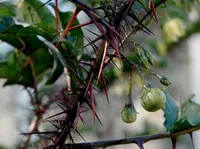
The five-minute plant, Solanum atropurpureum, is an unusual shrubby nightshade grown mainly as an ornamental curiosity. It forms stiff, upright stems covered in sharp purple thorns and carries lobed leaves and small, star-shaped flowers that resemble other Solanum species.
Native to parts of South America, it prefers warm conditions and is typically grown outdoors in mild climates or in protected spaces such as greenhouses. The plant is short-lived but fast-growing, which encourages seasonal use in ornamental plantings.
Spines, fast growth, and a tendency to self-seed can make it more demanding to manage, especially in small spaces. A sunny position, well-drained soil, and moderate moisture are usually enough to care for five-minute plant.

Care Difficulty
Moderate Care

Light Preference
Full Sun

Water Requirements
Moderate Water

Temperature Preference
Tropical / Frost Sensitive

Hardiness Zone
10–11

Soil Texture
Loamy, Sandy, Organic-rich

Soil pH
Acidic (5.5–6.5), Slightly acidic (6.5–7.0)

Soil Drainage
Well-drained

Fertilization
Light (every 4–6 weeks)
Scan your plant to receive care tips personalized for your specific plant
Available on iOS and Android
Solanum atropurpureum needs strong light to flower and develop sturdy growth.
This species prefers consistently moist but not saturated soil once established.
This plant responds best to warm, frost-free conditions with moderate seasonal shifts.
This species tolerates a broad humidity range but grows best with moderate air moisture.
This plant prefers freely draining, moderately fertile soil that does not stay wet for long.
This species is suitable for container growing, especially where outdoor space or climate is limited.
Solanum atropurpureum benefits from light, controlled feeding during its active growing season.
Solanum atropurpureum responds well to thoughtful pruning that manages its size and thorny branches.
This species is usually grown outdoors, so focus on careful transplanting or occasional pot up, not frequent repotting.
Solanum atropurpureum is most commonly propagated from seed, though semi-ripe cuttings are also possible.
In mild climates, Solanum atropurpureum acts as a tender perennial, but in colder areas it is usually grown as an annual.

Plant Health Check
Not sure what's wrong with your plant? Check your plant's health inside the app.
This species develops dense, rigid spines not only on the stems but also on the leaf veins and even the fruit surface, forming a mechanical barrier against herbivores. The contrast between its ornamental look and heavily armed tissues is unusually pronounced within the nightshade family.
The dark purple to nearly black coloration of its stems and petioles comes from high levels of anthocyanins, pigments that can help protect tissues from intense light and other environmental stresses. This pigmentation also contributes to its common names such as purple devil and malevolence.
Its orange, spiny berries are considered poisonous, consistent with many members of the genus Solanum. They are ornamental only and are not regarded as safe for human or pet consumption.

The species is native to parts of Brazil and neighboring regions and has escaped cultivation in some areas, where its aggressive spines and seed production have led to concern about its potential as an invasive, hard-to-handle garden escapee.
All parts are toxic if eaten, especially the berries, and sharp spines can pierce skin. Keep away from children, pets, and livestock, use gloves when handling, and avoid planting where accidental contact is likely.
Keep your plants happy and healthy with plant identification, disease detection, and easy care guidance.