Clustered planting layout
Plant several clumps 20–30 cm apart in the same bed or container to create a dense stand that shades its own roots and keeps the medium cooler and more evenly moist in summer.

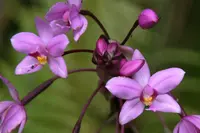
The Philippine ground orchid, Spathoglottis plicata, is a terrestrial orchid that grows in soil rather than on trees. It forms clumps of pleated leaves and upright flower spikes.
Flowers are usually purple, pink, or white and appear repeatedly in warm conditions, giving a long blooming season. The plant has a compact, neat habit that suits borders, patio containers, and tropical-style plantings.
In nature, it occurs in the Philippines and across parts of Southeast Asia and the Pacific, often in open, sunny, or lightly shaded spots with moist, well-drained ground. Its tolerance of warmth, humidity, and regular moisture makes it relatively straightforward to care for Philippine ground orchid for gardeners in mild or tropical climates.

Care Difficulty
Moderate Care

Light Preference
Partial Sun

Water Requirements
Keep Soil Moist

Temperature Preference
Tropical / Frost Sensitive

Hardiness Zone
10–11

Soil Texture
Loamy, Sandy, Organic-rich

Soil pH
Acidic (5.5–6.5), Slightly acidic (6.5–7.0)

Soil Drainage
Moist but well-drained

Fertilization
Moderate (every 2–4 weeks)
Scan your plant to receive care tips personalized for your specific plant
Available on iOS and Android
This terrestrial orchid prefers bright conditions with protection from intense midday sun.
This species prefers evenly moist, well-drained soil without staying soggy.
This orchid grows best in warm, frost-free conditions.
This terrestrial orchid prefers moderately humid air and reacts quickly to very dry conditions.
Spathoglottis plicata grows best in loose, moist, sharply drained soil that still holds organic matter.
This species adapts well to container growing when the pot supports its upright, clumping habit.
Spathoglottis plicata responds well to moderate, consistent feeding during active growth for steady foliage and flower production.
Spathoglottis plicata benefits from light, targeted pruning to keep clumps tidy and support flowering.
This terrestrial orchid prefers occasional division and transplanting rather than frequent repotting disturbances.
This species is most commonly propagated by division of mature clumps rather than from seed in home settings.
This warm-growing terrestrial orchid is frost sensitive and needs protection in regions with cold winters.

Plant Health Check
Not sure what's wrong with your plant? Check your plant's health inside the app.
Unlike many ornamental orchids that grow on trees, this species is a true terrestrial orchid that forms underground pseudobulbs and fibrous roots in soil, often in open, disturbed ground and roadside banks.
Wild populations show natural flower color variation from purple to lilac and occasionally white or pale pink, a trait that has been used by breeders to develop many garden forms.
In parts of its native range in Southeast Asia and the Pacific, this orchid often colonizes cleared or disturbed sites, acting as a pioneer species that can stabilize exposed soil and take advantage of increased light.

This orchid has become naturalized far beyond its native range, including in Florida, Hawaii, and several Pacific islands, where it can escape from cultivation and establish self-sustaining populations in warm, frost-free areas.
Lack of blooms usually comes from low light, depleted nutrients, or an overcrowded clump. Ensure bright conditions, feed with a balanced orchid fertilizer during the growing season, and divide congested clumps to restore flowering.
Keep your plants happy and healthy with plant identification, disease detection, and easy care guidance.