


Controlled pot crowding
Allow the plant to become slightly rootbound in a snug, heavy pot, as mild crowding encourages more blooms and keeps the fleshy stems from toppling over.

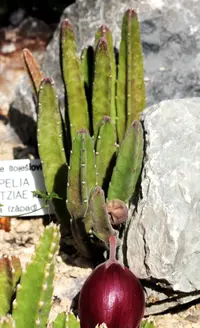
Black bells, Stapelia leendertziae, is a small, clump-forming succulent from arid regions of South Africa. It grows low to the ground with thick, angular, leafless stems.
The plant is best known for its large, dark maroon, bell-shaped flowers with a waxy, almost leathery texture and a carrion-like scent that attracts flies for pollination.
It suits growers who enjoy unusual succulents and can tolerate the occasional odor when it blooms. Understanding how to care for black bells starts with providing bright light, fast-draining soil, and careful, infrequent watering.

Care Difficulty
Moderate Care

Light Preference
Partial Sun

Water Requirements
Low Water

Temperature Preference
Tropical / Frost Sensitive

Hardiness Zone
10–11

Soil Texture
Sandy, Loamy, Rocky

Soil pH
Slightly acidic (6.5–7.0), Neutral (7.0)

Soil Drainage
Well-drained

Fertilization
Minimal (feed rarely)
Scan your plant to receive care tips personalized for your specific plant
Available on iOS and Android
This succulent prefers bright, indirect light that mimics open shade in its native habitat.
Watering should mimic short rain events followed by dry spells.
This species prefers warm, dry conditions with mild temperature swings between day and night.
This succulent handles typical indoor humidity but prefers fairly dry air.
This plant needs a very fast-draining, airy mix to prevent root and stem rot.
This species is well suited to container growing.
Stapelia leendertziae is a light feeder, so modest, diluted nutrition is enough for steady growth in containers.
Stapelia leendertziae benefits from light, corrective pruning to maintain a healthy, open clump.
This succulent prefers a slightly snug pot and infrequent repotting to limit excess moisture around the roots.
Stapelia leendertziae is most commonly propagated from stem cuttings, which root well in warm, dry conditions.
This species is not frost hardy and needs cool, dry, frost-free conditions through winter, especially in containers.

Plant Health Check
Not sure what's wrong with your plant? Check your plant's health inside the app.
This species produces large, deeply bell-shaped, dark maroon to almost black flowers that mimic the appearance and smell of rotting meat to attract carrion flies for pollination.
The inner surface of the flower is slippery and funnel-like, guiding flies toward the central reproductive structures where pollen packets (pollinia) can attach to the insects before they escape.
Its thick, 4-angled green stems act as water-storage organs, an adaptation to the arid habitats of southern Africa where it experiences long dry periods.

In its native range in southern Africa, this species often grows in the partial shade of rocks or low shrubs, using their protection to avoid intense midday sun while still receiving enough light to flower successfully.
Lack of flowers usually comes from insufficient light, a pot that is too large, or excess nitrogen fertilizer. Cooler, bright conditions and a brief dry rest between waterings often trigger buds and improve Stapelia leendertziae care.
Keep your plants happy and healthy with plant identification, disease detection, and easy care guidance.

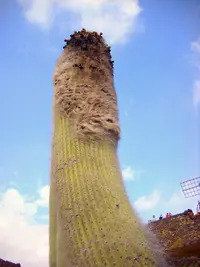
Old man cactus
Cephalocereus senilis
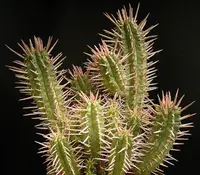
Thorn Noors
Euphorbia ferox
 POPULAR
Cape jasmine
Gardenia jasminoides
Aeschynanthus hookeri
Aeschynanthus hookeri
queen of the night
Selenicereus grandiflorus
Red Echeveria
Echeveria harmsii
Euphorbia poisoni
Euphorbia poissonii
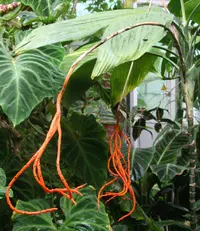
Chamaedorea ernesti-augusti
Chamaedorea ernesti-augusti