Select proper host
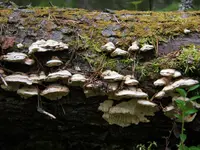
Encourage growth on well-decayed hardwood logs or stumps from oak, beech, or similar broadleaf species, since this fungus establishes more reliably on already colonized, moist wood than on fresh timber.

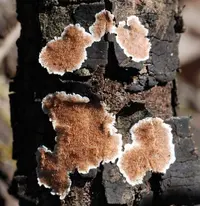
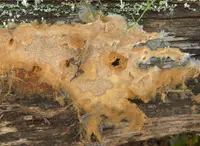
Ochre spreading tooth, Steccherinum ochraceum, is a crust-like wood-decay fungus rather than a leafy plant. It forms thin, ochre to cream patches with tiny tooth-like spines on dead branches and logs.
It is widespread in temperate forests, especially in Europe and North America, where it plays an important role in breaking down fallen wood. The fungus is specialized and slow-growing, so attempts to care for Ochre Spreading Tooth in home settings are usually challenging.
It prefers consistently cool, humid, shaded conditions and well-decayed wood as its substrate, rather than soil. This makes it better suited to naturalistic woodland or outdoor habitat projects than typical indoor cultivation.

Care Difficulty
Moderate Care

Light Preference
Shade

Water Requirements
Keep Soil Moist

Temperature Preference
Cool Climate

Hardiness Zone
Unknown

Soil Texture
Loamy, Silty, Organic-rich

Soil pH
Strongly acidic (4.5–5.5), Acidic (5.5–6.5)

Soil Drainage
Moist but well-drained

Fertilization
Minimal (feed rarely)
Scan your plant to receive care tips personalized for your specific plant
Available on iOS and Android
This wood-decaying fungus prefers low to moderate forest light similar to its natural habitat.
This fungus depends on consistently moist, but not waterlogged, wood or woody debris.
This species thrives in cool to mild woodland temperatures throughout much of the year.
This wood-decay fungus prefers consistently moist, humid woodland conditions and is not suited to dry indoor air.
Steccherinum ochraceum grows on decaying wood rather than in true soil, so conditions must mimic rotting logs.
This species is not naturally suited to conventional container growing, but it can colonize sections of dead wood kept in trays or boxes.
This wood-decaying fungus usually grows on nutrient-rich dead wood and does not need additional fertilizer in cultivation.
Pruning needs for Steccherinum ochraceum are minimal and mainly relate to host tree management rather than the fungus itself.
Transplanting is seldom attempted, as this fungus depends on established dead wood rather than conventional soil-based container culture.
Propagation of Steccherinum ochraceum is specialized and generally left to natural spore dispersal on suitable dead wood.
This fungus is cold hardy in its natural range and usually needs no special winter care.

Plant Health Check
Not sure what's wrong with your plant? Check your plant's health inside the app.
This crust fungus forms a smooth to slightly felty surface that develops short, bristle-like teeth rather than gills or pores, a diagnostic feature used by mycologists to separate it from many other wood-decaying fungi.
It frequently colonizes thin twigs, small branches, and bark in temperate forests, acting as an early decomposer that helps break down fine woody debris and recycle nutrients back into the ecosystem.
On dead wood it often forms extensive, continuous patches that can overgrow or border other corticioid fungi, indicating a relatively strong competitive ability in the microscopic community on decaying branches.

This species is widely distributed across the Northern Hemisphere and is so frequently encountered on small fallen branches that field mycologists often use it as a familiar reference organism when teaching crust fungi identification.
This crust fungus can spread widely across dead wood surfaces, forming extensive patches over time. It is not invasive in the usual horticultural sense, but in suitable decaying wood it can gradually dominate available substrate.
Keep your plants happy and healthy with plant identification, disease detection, and easy care guidance.