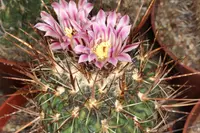
Rotate for symmetry
Turn the pot 90° every 2–3 weeks during active growth so the ribs develop evenly and the plant does not lean toward the strongest light source.

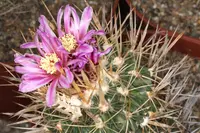
Stenocactus crispatus is a small desert cactus known for its many narrow, wavy ribs that create a distinctive, sculpted look. It usually stays compact, forming a rounded stem with stiff, pale spines.
This species is native to arid regions of central Mexico, where it grows in rocky, well-drained soils under strong sun. It produces small, funnel-shaped flowers near the crown, typically in pale cream or purple tones.
Stenocactus crispatus suits growers who prefer a slow-growing plant that needs bright light, minimal watering, and gritty, fast-draining soil. Understanding how to care for Stenocactus crispatus mainly involves avoiding overwatering and providing enough light.

Care Difficulty
Easy Care

Light Preference
Full Sun

Water Requirements
Low Water

Temperature Preference
Tropical / Frost Sensitive

Hardiness Zone
10–11

Soil Texture
Sandy, Rocky, Loamy

Soil pH
Slightly acidic (6.5–7.0), Neutral (7.0)

Soil Drainage
Well-drained

Fertilization
Minimal (feed rarely)
Scan your plant to receive care tips personalized for your specific plant
Available on iOS and Android
This compact cactus thrives in bright, mostly direct sun with some protection in extreme heat.
This desert cactus prefers thorough but infrequent watering with fast drainage.
This species prefers warm, dry conditions and does not tolerate hard frost.
This cactus prefers dry indoor air and rarely needs humidity adjustment.
Use a very fast-draining, mineral-rich mix to prevent root rot in Stenocactus crispatus.
This species is well suited to container growing due to its compact root system and slow growth.
This cactus needs only light feeding, as it is adapted to low-nutrient desert soils.
Pruning needs are minimal and focus on health and safety rather than shaping.
This slow-growing cactus prefers to stay slightly root-bound and only needs infrequent repotting.
Propagation is usually done from seeds, as offsets are uncommon on this species.
This cactus needs a cool, very dry winter rest and is not suited to prolonged freezing conditions.

Plant Health Check
Not sure what's wrong with your plant? Check your plant's health inside the app.
This species typically develops 20–30 or more very narrow ribs, which is unusually high and gives the stem its characteristic strongly wavy, corrugated appearance compared with many other small globular cacti.
Mature plants often show flattened, slightly twisted central spines that can curve and interlock over the body, creating a dense protective cage that shades the epidermis and reduces water loss in its sunny, semi-arid habitat.
In habitat, this cactus remains relatively small and slow-growing, usually staying single-headed for many years, an adaptation that limits water demand and allows survival on sparse, irregular rainfall in northeastern Mexico.

Field studies have reported that this species commonly grows partially sunken into gritty limestone soils, with only the ribbed crown exposed above ground, which helps buffer temperature extremes and protects the plant from herbivores and desiccating winds.
This species grows slowly, usually adding only a few millimeters of diameter each year. In good conditions it may reach 5–10 cm across over many years, so patience is essential when growing Stenocactus crispatus.
Keep your plants happy and healthy with plant identification, disease detection, and easy care guidance.