

Select Correct Substrate
Inoculate only freshly cut hardwood logs or branches with intact bark, as Stereum rugosum establishes poorly on heavily decayed or barkless wood.

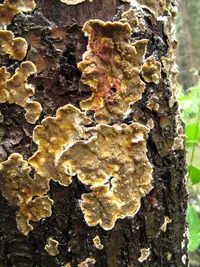
Broadleaf bleeding-crust (Stereum rugosum) is a wood-decaying fungus, not a traditional houseplant. It forms thin, crust-like, often overlapping brackets on dead or dying broadleaf trees, especially beech, maple, and oak. The upper surface is rough and zoned in brown tones, while the underside is smooth and spore-producing.
This species is widespread in temperate forests of Europe, North America, and parts of Asia, where it plays an important role in breaking down hardwood. It is not commonly cultivated, and attempts to care for Broadleaf Bleeding-crust focus on providing continuously moist, shaded, decaying wood rather than soil.
Because it is specialized for life on dead wood, it is generally considered difficult to grow in typical garden or indoor conditions.

Care Difficulty
Moderate Care

Light Preference
Partial Shade

Water Requirements
Regular Water

Temperature Preference
Cold Hardy

Hardiness Zone
4–9

Soil Texture
Loamy, Organic-rich

Soil pH
Acidic (5.5–6.5), Slightly acidic (6.5–7.0)

Soil Drainage
Moist but well-drained

Fertilization
Minimal (feed rarely)
Scan your plant to receive care tips personalized for your specific plant
Available on iOS and Android
This wood-decay fungus is adapted to shaded woodland conditions rather than open sun.
This fungus relies on consistent natural moisture in the host wood rather than surface watering.
This species is broadly cold-tolerant but fruits best in cool to mild conditions.
Humidity is not a primary concern for this wood-decay fungus, which naturally colonizes outdoor logs and branches.
This fungus grows on dead or decaying wood rather than in conventional soil, so focus on the substrate rather than potting mixes.
This species is not well suited to traditional container growing, as it is a wood-decay fungus that requires dead timber rather than potting media.
This wood-decay fungus grows on nutrient-rich dead hardwood and typically does not need supplemental fertilizer in cultivation.
Pruning is not a standard practice for Stereum rugosum, since it fruits on dead or dying wood rather than forming a conventional plant canopy.
In gardens or educational displays, this species is managed by renewing or repositioning its host wood rather than true repotting.
Propagation of this bracket fungus is usually left to natural spore dispersal and is not commonly attempted in home settings, so specific how-to steps are rarely necessary.
This hardy, wood-inhabiting fungus generally requires no special winter care in temperate climates, as the mycelium tolerates normal outdoor freezes.

Plant Health Check
Not sure what's wrong with your plant? Check your plant's health inside the app.
When the fruiting body is damaged, especially when fresh and moist, it can exude a distinct reddish fluid that resembles blood, which is the origin of the common name broadleaf bleeding-crust.
This species almost exclusively colonizes dead or dying broadleaf wood, particularly of maple, beech, and other deciduous trees, and is rarely if ever found on conifers.
Although each bracket is very thin and tough, the crust can persist on the same log for several seasons, producing new concentric growth zones as conditions allow.

Molecular studies have shown that Stereum rugosum is part of a complex of visually similar crust fungi, and DNA sequencing is now often required to distinguish it confidently from close relatives that share almost identical colors and shapes.
This bracket fungus is considered inedible due to its very tough, woody texture and lack of culinary value. It is not known to be dangerously toxic, but it should not be harvested or used as food.
Keep your plants happy and healthy with plant identification, disease detection, and easy care guidance.

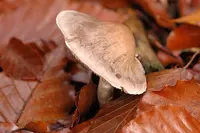
variable webcap
Cortinarius anomalus
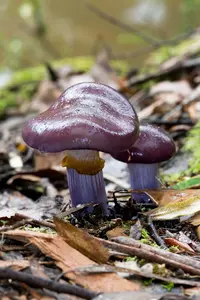
Emperor Cortinar
Cortinarius archeri
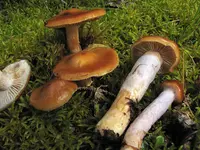
blue-girdled webcap
Cortinarius collinitus
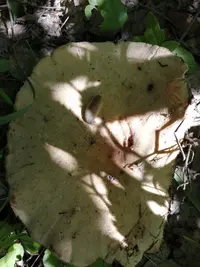
Neolentinus cyathiformis
Neolentinus cyathiformis
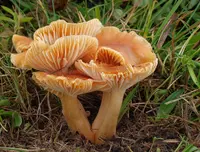
Meadow Waxcap
Cuphophyllus pratensis
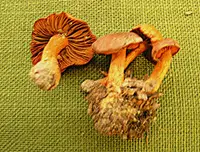
cinnabar webcap
Cortinarius cinnabarinus
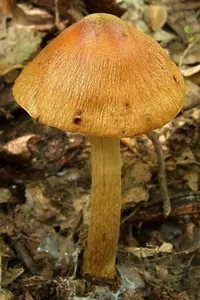
wrinkled cortinarius
Cortinarius corrugatus
goatcheese webcap
Cortinarius camphoratus