Understory placement
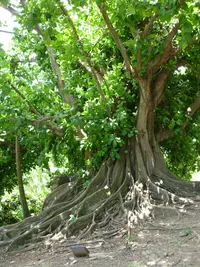
Site the plant among taller, deep-rooted trees so it benefits from light dappled shade and shared soil moisture without competing directly with aggressive, shallow-rooted species like maples.

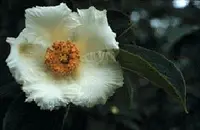
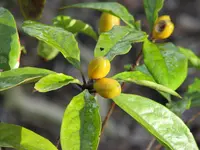
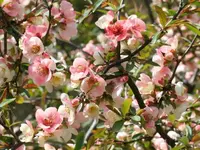
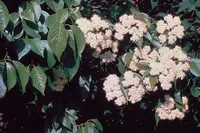
Mountain camellia, Stewartia ovata, is a small deciduous tree or large shrub valued for its camellia-like white flowers with showy yellow centers. It typically has a rounded, multi-stemmed habit and smooth, patterned bark that adds interest even when the plant is not in bloom.
This species is native to the southeastern United States, where it grows in cool, moist woodland ravines and along shaded slopes. It prefers dappled light, evenly moist, acidic soil, and good drainage, which can make it a bit more demanding than common garden shrubs.
Gardeners who learn how to care for mountain camellia gain a long-lived, refined ornamental suited to sheltered gardens, woodland plantings, and naturalistic landscapes.

Care Difficulty
Moderate Care

Light Preference
Partial Shade

Water Requirements
Regular Water

Temperature Preference
Cold Hardy

Hardiness Zone
5–8

Soil Texture
Loamy, Sandy, Organic-rich

Soil pH
Strongly acidic (4.5–5.5), Acidic (5.5–6.5)

Soil Drainage
Moist but well-drained

Fertilization
Minimal (feed rarely)
Scan your plant to receive care tips personalized for your specific plant
Available on iOS and Android
This deciduous tree prefers bright but gentle light to support healthy foliage and flowers.
This species prefers steadily moist, cool soil without long dry spells or standing water.
This tree is hardy in temperate climates but still benefits from stable, moderate temperatures for best growth.
This species prefers moderate ambient humidity but usually adapts to typical household or outdoor levels.
Stewartia ovata needs consistently moist, well-structured soil that stays aerated and never waterlogged.
This tree can be grown in containers for several years, but it remains a long-term challenge due to eventual size and root needs.
This native tree benefits from light feeding but often grows acceptably in rich, undisturbed soil, so fertilization for mountain camellia should stay modest.
Stewartia ovata needs only light, careful pruning to maintain structure and health without spoiling its natural form.
This species is usually grown in the ground, so focus on careful planting and minimal root disturbance rather than frequent repotting.
Stewartia ovata is slow and somewhat challenging to propagate, so it is not commonly multiplied at home.
Established Stewartia ovata trees are generally cold hardy in suitable climates and need only modest winter attention.

Plant Health Check
Not sure what's wrong with your plant? Check your plant's health inside the app.
This species occurs naturally along cool, rocky streams and moist slopes in the southern Appalachian region, where it often grows in partially shaded, acidic forest soils with high organic matter.
Its large, white, camellia-like flowers appear in early to midsummer, which is unusually late for a member of the tea family (Theaceae), extending the flowering season in woodland habitats when many spring shrubs are no longer in bloom.
Stewartia ovata has a relatively narrow, scattered distribution in parts of Tennessee, North Carolina, Georgia, Alabama, and nearby states, and is considered locally uncommon due to its specific habitat requirements.

The bark of Stewartia ovata exfoliates in irregular patches to reveal mottled shades of gray, brown, and sometimes orange beneath, giving mature trunks a decorative, puzzle-like pattern that is highly valued in four-season ornamental planting.
Lack of flowers usually comes from too much shade, heavy pruning at the wrong time, or stress from drought or root disturbance. Ensure stable moisture, minimal pruning after bud set, and protection from late frosts that damage buds.
Keep your plants happy and healthy with plant identification, disease detection, and easy care guidance.