Staggered Deadheading
Remove spent flowers every 3–4 days by cutting just above a leafy node to extend the blooming period and encourage a dense, compact mound of new buds.

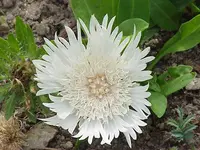
Stokes' aster (Stokesia laevis) is a compact, clump-forming perennial grown mainly for its showy, daisy-like flowers. It usually forms low mounds of narrow, evergreen to semi-evergreen leaves.
Flower colors range from soft blue and lavender to white, with a ruffled, fringed look that attracts bees and butterflies. The plant is native to the southeastern United States, where it grows in open, sunny sites with well-drained soil.
It is considered relatively easy to grow, provided it has good drainage and is not kept constantly wet. Gardeners who learn how to care for Stokes' aster appreciate its long bloom period and tidy habit.

Care Difficulty
Easy Care

Light Preference
Full Sun

Water Requirements
Moderate Water

Temperature Preference
Cold Hardy

Hardiness Zone
5–9

Soil Texture
Sandy, Loamy

Soil pH
Acidic (5.5–6.5), Slightly acidic (6.5–7.0)

Soil Drainage
Well-drained

Fertilization
Minimal (feed rarely)
Scan your plant to receive care tips personalized for your specific plant
Available on iOS and Android
This perennial thrives in full sun but accepts light shade, especially in hotter climates.
This plant prefers evenly moist, well-drained soil that dries slightly between waterings.
This hardy perennial tolerates a wide temperature range but performs best in moderate conditions.
Humidity is rarely a concern for this drought-tolerant perennial grown outdoors in typical garden conditions.
Stokesia laevis prefers freely draining, moderately fertile soil that does not stay wet after rain.
This species grows reliably in containers if drainage and stability are managed carefully.
Light feeding supports flowering in this drought-tolerant perennial without causing lush, floppy growth.
Thoughtful pruning keeps Stokesia laevis compact, tidy, and flowering well.
This perennial is usually grown in garden beds, so focus on dividing and transplanting established clumps rather than frequent repotting.
Stokesia laevis is commonly propagated by division and can also be raised from seed under the right conditions.
This perennial is reasonably cold hardy in much of its range and usually needs only modest winter preparation.

Plant Health Check
Not sure what's wrong with your plant? Check your plant's health inside the app.
The flower heads have finely fringed ray florets surrounding a central disc, giving a thistle-like look even though the plant belongs to the Asteraceae family rather than the true thistles in Cirsium or Carduus.
This species is native to the coastal plain of the southeastern United States, especially in the Carolinas, Georgia, and Florida, where it grows in open pinewoods, savannas, and moist, sandy clearings.
Unlike many ornamental asters that struggle in hot, humid summers, this species evolved in warm, moisture-laden coastal climates and typically maintains good foliage and flower quality under those conditions.

The species honors the 18th-century Scottish physician and botanist Jonathan Stokes, who was a student and collaborator of William Withering, the physician famous for introducing digitalis from foxglove into clinical medicine.
Yes, this species is highly attractive to butterflies, bees, and other pollinators. Its open, nectar-rich flower heads provide an excellent food source, making it a good choice for wildlife-friendly and pollinator-focused garden plantings.
Keep your plants happy and healthy with plant identification, disease detection, and easy care guidance.