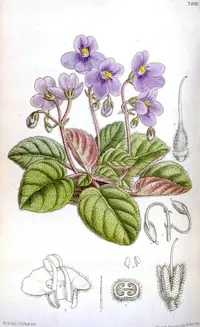








African Violet (Streptocarpus ionanthus) Light Needs

African Violet grows best in bright, indirect light with only gentle morning sun, if any.

Light Preference

Bright Indirect Light

Streptocarpus ionanthus Light Requirements

In its native East African habitat, Streptocarpus ionanthus grows in humid, sheltered sites, often on shaded rocks and forested slopes. Light is bright but softened by overhead growth, mist, and frequent cloud cover, not open all-day sun. Sun reaches it mainly as brief, angled exposure.

This background explains its indoor preference for strong ambient light without harsh rays. It prefers bright, indirect or filtered light.

  • Ideal exposure:

    African Violet needs about 8–12 hours of bright, indirect or filtered light daily, including up to 1–2 hours of gentle direct morning sun.

  • Direct sun limit:

    Early sun is usually tolerated, but midday and afternoon rays can scorch the thin, fuzzy leaves.

  • Lower light:

    Shade is tolerated for survival, but dim rooms often reduce flowering and create stretched growth.

  • Morning angle:

    Cool morning light is safer than late-day sun, especially near warm glass.

Indoors, window direction matters because this plant needs strong light without hot direct rays.

NConditional
North-facing window:

Use a bright, unobstructed north window only if the plant sits very close to the glass and still flowers.

EBest
East-facing window:

Place it close to an east-facing window where soft morning sun reaches the leaves for a short time.

SConditional
South-facing window:

Set it 3–5 ft from a south-facing window, or closer behind a sheer curtain that filters direct sun.

WConditional
West-facing window:

A west-facing window is risky unless the plant is set back 4–6 ft or protected by a sheer curtain.

Choose the brightest spot that keeps leaves out of hot afternoon sun.

Excess light usually shows first on the exposed leaf surfaces.

Bleached patches:

Pale tan or whitish areas can appear where direct rays hit the leaf, especially after a sudden move.

Crisp spots:

Sunburn may form dry, papery spots on the upper leaves rather than evenly across the plant.

Flattened foliage:

Leaves may lie lower and look dull when light and heat are stronger than the plant can use.

Faded blooms:

Flowers can fade faster in intense sun, particularly near hot glass.

Move it out of direct afternoon sun and filter the window with a sheer curtain. Damaged areas will not green up, but new growth should look more even.

Low light often develops gradually, especially in winter or far from a window.

  • Few flowers:

    The plant may make healthy-looking leaves but produce few buds when light is too weak.

  • Long leaf stems:

    Leaf stalks can stretch upward or outward as the crown reaches toward brighter light.

  • Leaning crown:

    Growth may tilt toward the window instead of staying balanced in the pot.

  • Small new leaves:

    New leaves may emerge smaller and paler when the plant lacks usable light.

Move it closer to a bright window with filtered light, or add steady artificial light. Increase exposure gradually if the plant has been in shade.

If the ideal spot is unavailable, choose bright shade over direct afternoon sun; this species tolerates a little less light better than scorched leaves.

Set the pot within the brightest usable area, then rotate it a quarter turn every week to keep the crown even.

Avoid shelves more than a few feet from natural or artificial light, because flowering is usually poor there.

Get Personalized Care Plan

Scan your plant to receive care tips personalized for your specific plant

FAQ

The best light for African Violet is bright, indirect or filtered light for most of the day, with only brief gentle morning sun if conditions are cool.

Everything About African Violet

More Plant Light Guides

Get the Botan App

Discover how to care for your plants with Botan.

Botan app identifying a plant with a phone camera
How to Winterize Your Garden in 6 Steps

5 min read · 28 Sept 2026

How to Winterize Your Garden in 6 Steps

Learn how to prepare your garden for winter with a practical six-step checklist covering cleanup, tender plant care, watering, mulching, winter protection, and winterizing equipment and containers.

Plant Care
How to Winterize Your Garden in 6 Steps
Is Sugar Water Good for Plants?

4 min read · 14 Sept 2026

Is Sugar Water Good for Plants?

Sugar water may sound like an easy boost, but most rooted plants do not need extra sucrose. This guide explains how green tissues produce carbohydrates, when a sweetened solution can be useful, and why too much can cause problems.

Plant Care
Is Sugar Water Good for Plants?
12 Best Cold-Hardy Vegetables for Cold Weather

7 min read · 13 Oct 2026

12 Best Cold-Hardy Vegetables for Cold Weather

Cold-hardy vegetables can keep a garden productive through chilly fall, winter, and early spring weather. This guide covers 12 reliable crops, their frost tolerance, and practical growing tips for better cold-season harvests.

Plant Recommendations
12 Best Cold-Hardy Vegetables for Cold Weather