Stromanthe Care (Stromanthe thalia 'Triostar')

Also known as: Never Never Plant
Stromanthe

About Stromanthe

Stromanthe thalia 'Triostar' is a tropical, rhizomatous perennial grown mainly as an indoor foliage plant. It belongs to the Marantaceae family, often called prayer plants for their leaf movement.

This cultivar has striking variegated leaves in cream, green, and pink tones, with deep pink undersides, and forms a dense, bushy clump rather than climbing. In its natural habitat in Brazil, it grows on the forest floor, protected by taller vegetation.

Its need for stable warmth, high humidity, and gentle, filtered light makes it moderately challenging, especially in dry or drafty homes. Understanding how to care for Stromanthe helps prevent leaf browning and color loss, particularly through consistent moisture and airy, organic-rich soil.

Main Plant Requirements

Care Difficulty

Moderate Care

Light Preference

Bright Indirect Light

Water Requirements

Keep Soil Moist

Temperature Preference

Tropical / Frost Sensitive

Hardiness Zone

10–12

Soil Texture

Loamy, Peaty, Organic-rich

Soil pH

Acidic (5.5–6.5), Slightly acidic (6.5–7.0)

Soil Drainage

Moist but well-drained

Fertilization

Light (every 4–6 weeks)

Get Personalized Care Plan

Scan your plant to receive care tips personalized for your specific plant

Available on iOS and Android

How to Care for the Stromanthe

This plant prefers bright, gentle light that mimics a forest understory.

  • Provide 6–8 hours of bright, indirect light each day, such as an east window with morning sun or a few feet back from a bright window.
  • Avoid direct midday or afternoon sun, which can bleach variegation and cause brown, crispy patches on Stromanthe leaves.
  • In winter, move the plant closer to bright windows or use sheer curtains to maintain light levels while still filtering harsh rays.

Watering should keep the root zone evenly moist but never saturated.

  • Water when the top 2–3 cm of soil feel dry, letting water flow through drainage holes, then discard excess from saucers or cachepots.
  • Use a loose, well‑draining mix; persistent wetness, sour smell, or limp, yellowing lower leaves suggest overwatering in Stromanthe thalia 'Triostar'.
  • In brighter, warmer months, expect faster drying; in cooler, low‑light seasons, let the top layer dry a bit deeper and watch for curling, crisp edges as a sign of underwatering.

Stable, warm conditions support steady growth and help prevent leaf damage.

  • Aim for 65–80°F (18–27°C) for active growth, avoiding sudden swings that stress the plant and dull leaf color.
  • Protect it from temperatures below 60°F (16°C); prolonged exposure near 50°F (10°C) can cause leaf drop, and frost will kill foliage.
  • In hot spells above 85°F (29°C), increase humidity, shade from intense sun, and ensure good air movement to limit heat stress and leaf scorch.

This plant needs consistently high humidity to keep foliage healthy and avoid brown edges.

  • Aim for 60–70% humidity; it tolerates brief dips to 40–50% but growth and leaf color may suffer.
  • Dry air causes crispy brown margins, curled leaves, and reduced movement of leaf blades.
  • Increase humidity with a room humidifier, grouped plants on pebble trays, and by keeping it away from heating or AC drafts.

Stromanthe thalia 'Triostar' prefers a light, airy, organic-rich mix that drains quickly but stays slightly moist.

  • Use a peat- or coco-coir-based mix with plenty of fine bark, perlite, or pumice to increase drainage and aeration.
  • Target a slightly acidic pH around 5.5–6.5, similar to many aroid and prayer plant relatives.
  • Ensure the mix feels springy and loose in hand; compact, heavy, or sticky textures promote root suffocation and rot.
  • Avoid straight garden soil, dense clay, or mixes with lots of fine sand, which hold water unevenly and limit oxygen around roots.

This species is well suited to container growing due to its clumping, shallow root system.

  • Choose a pot just 2–4 in wider than the root mass so the mix does not stay wet for too long after watering.
  • Select a stable, heavier container if the foliage fan makes the plant prone to tipping on tall stands.
  • Use a pot material that moderates moisture, such as glazed ceramic or thick plastic, to reduce rapid drying of the upper root zone.

Nutrient support keeps Stromanthe thalia 'Triostar' foliage strong and evenly colored in active growth.

  • Use a balanced liquid fertilizer (around 10-10-10 or 20-20-20) diluted to 1/4–1/2 strength for container plants.
  • Feed every 4–6 weeks from spring through early fall when growth is steady.
  • Skip or halve feedings in winter, as lower light and cooler temperatures slow nutrient use.
  • Avoid compost or strong slow-release products that can burn sensitive roots in small indoor pots.

Light pruning keeps Stromanthe thalia 'Triostar' tidy and encourages fresh foliage.

  • Best time for pruning is late winter to early spring, before strong new growth starts.
  • Use clean, sharp scissors or pruners to remove yellow, brown, or torn leaves at the base.
  • Trim excessively tall or crowded stems to maintain a balanced, compact form.
  • Remove spent flower stalks at the soil line to direct energy back into foliage growth.

Occasional repotting supports healthy roots and stable moisture for Stromanthe thalia 'Triostar'.

  • Check for roots circling the pot, pushing through drainage holes, or noticeably slower growth as signals to repot.
  • Plan repotting every 2–3 years in spring, when new growth begins and recovery is quickest.
  • Choose a pot 2–3 cm wider with good drainage and use a light, peat-free, chunky indoor mix.
  • Water well before and after repotting, handle roots gently, and keep the plant shaded and evenly moist for 1–2 weeks to limit stress.

Division is the standard method for increasing Stromanthe thalia 'Triostar' plants.

  • Divide established clumps in spring or early summer, when roots are actively growing.
  • Remove the plant from its pot, gently tease soil away, and separate rhizomes so each section has roots and at least 2–3 healthy shoots.
  • Plant divisions into small pots with airy, moist, well-drained mix and firm lightly around roots.
  • Maintain high humidity, bright indirect light, and stable warmth (68–80°F) to support quick re-establishment.

This tropical plant is frost-sensitive and needs indoor-style winter care in most climates.

  • Keep indoor temperatures around 65–75°F and avoid cold drafts or sudden temperature drops.
  • Move any outdoor containers indoors before temperatures fall below 55°F.
  • Reduce watering slightly in winter, keeping soil just lightly moist and never saturated.
  • Provide bright, filtered light and, if possible, 50–60% humidity to prevent leaf edge browning.

Care Tips

Rotate for balance

Rotate the pot 1/4 turn every 1–2 weeks to keep growth upright and prevent the plant from leaning or producing lopsided foliage.

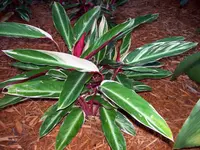
Protect leaf variegation

Keep the plant at least 60–90 cm away from cold windows and strong drafts, since temperature stress can cause browning on the white and pink leaf areas and reduce variegation quality.

Use pebble trays

Place the pot on a wide tray filled with water and pebbles (pot above water level) to create a stable humidity buffer around the foliage, especially helpful in heated or air-conditioned rooms.

Shower to clean foliage

Every 4–6 weeks, give the plant a gentle lukewarm shower or wipe leaves with a soft damp cloth to remove dust, which improves light capture and makes early pest detection easier when caring for Stromanthe.

Support long petioles

If older leaves start to flop outward, add a low, open plant ring or a few discreet stakes near the pot edge to keep petioles supported and reduce mechanical damage when moving or cleaning the plant.

Common Pests and Diseases

Spider mites

This pest thrives in dry indoor air and causes fine stippling, dulling of the variegation, and very fine webbing on leaf undersides and between petioles.

Solution

Shower the plant thoroughly, focusing on leaf undersides, then repeat every few days; increase humidity to 50–60%, isolate the plant, and apply a neem oil or insecticidal soap spray in several rounds to break the life cycle.

Mealybugs

These insects appear as white, cottony clusters in leaf axils, along stems, and sometimes on roots, causing yellowing, leaf curl, and sticky honeydew.

Solution

Remove visible insects with cotton swabs dipped in 70% isopropyl alcohol, rinse foliage with lukewarm water, then use a systemic insecticide or repeated insecticidal soap treatments while inspecting weekly for reinfestation.

Fungal leaf spot

This disease causes small water-soaked or brown spots that can expand and merge, especially on older or shaded leaves kept too wet, sometimes with a yellow halo.

Solution

Remove and discard affected leaves, avoid wetting the foliage, improve air movement around the plant, and water only when the top 2–3 cm of soil is dry; in persistent cases, apply a copper-based or broad-spectrum houseplant fungicide according to label directions.

Bacterial leaf blight

Symptoms include irregular, translucent or dark lesions that often start at the leaf edge or tip, spreading rapidly in warm, humid, poorly ventilated conditions.

Solution

Isolate the plant, cut off and discard affected leaves with sterilized tools, avoid overhead watering and splashing, allow the surface of the potting mix to dry slightly between waterings, and, if spread continues, discard the most affected plants to protect others nearby.

Thrips

These insects feed by scraping and sucking plant cells, leading to silvery streaks, distorted new leaves, and brown scarring along veins on the colorful foliage typical when growing Stromanthe.

Solution

Rinse foliage carefully, use sticky traps to monitor adults, then apply a contact treatment such as insecticidal soap combined with a systemic insecticide if allowed for indoor use, repeating every 7–10 days until new growth appears clean.

Interesting Facts

Natural Brazilian understory

This cultivar descends from wild Stromanthe populations native to the Atlantic Forest understory in Brazil, where it evolved under broken canopy light and consistently warm, humid air.

Variegation and photosynthesis

Its cream and pink variegation reduces the amount of chlorophyll-bearing tissue, so individual leaves photosynthesize less efficiently than fully green Stromanthe leaves, which is why this form grows more slowly than non-variegated relatives.

Leaf movement rhythm

Like many marantaceae, it has a pronounced nyctinastic response, lifting and folding its leaves upward at night and lowering them by day through specialized joints called pulvini at the base of each leaf stalk.

Botan icon

Did you know?

This cultivar is widely considered a stabilized ornamental selection rather than a naturally occurring wild form, meaning its striking pink-and-cream leaf pattern was fixed through deliberate horticultural selection from more subtly patterned Stromanthe ancestors.

FAQs about Stromanthe

Crispy brown edges usually result from low humidity, excessive fertilizer salts, or fluoride/chlorine in tap water. Increase humidity, flush the pot periodically, and use filtered or rested water to reduce mineral stress and leaf scorch.

Grow Healthy Plants with Botan Care

Keep your plants happy and healthy with plant identification, disease detection, and easy care guidance.

Botan plant care app — identify plants on mobile

Explore More Plants