Install sturdy support
Provide a strong trellis or horizontal wire grid early on and gently tie new vines with soft ties, as this woody climber quickly becomes rigid and difficult to redirect once stems thicken.

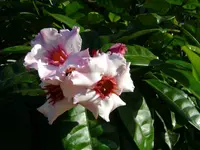
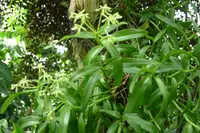
Strophanthus gratus is a woody climbing shrub native to tropical West Africa, often grown for its striking, star-shaped, white to pink flowers with long twisted tails. In cultivation it behaves like a vigorous vine, needing firm support and space to climb, which shapes how it fits into a garden or large indoor space.
The plant prefers warm, humid conditions, bright light, and well-drained soil, so it is usually grown in greenhouses or very sheltered outdoor spots. These specific requirements mean care for ouabain is better suited to experienced growers than complete beginners.

Care Difficulty
Hard Care

Light Preference
Partial Sun

Water Requirements
Regular Water

Temperature Preference
Tropical / Frost Sensitive

Hardiness Zone
11–12

Soil Texture
Sandy, Loamy, Organic-rich

Soil pH
Acidic (5.5–6.5), Slightly acidic (6.5–7.0)

Soil Drainage
Moist but well-drained

Fertilization
Light (every 4–6 weeks)
Scan your plant to receive care tips personalized for your specific plant
Available on iOS and Android
Strophanthus gratus thrives in bright, warm conditions that mimic open woodland edges.
Strophanthus gratus prefers evenly moist, well-draining soil without long periods of drought or saturation.
This species grows best in consistently warm, frost-free climates.
This species prefers moderately humid air and reacts quickly to very dry conditions.
Strophanthus gratus requires fast-draining, aerated soil that stays lightly moist but never heavy or waterlogged.
This vine adapts well to container growing when the pot and support are chosen carefully.
Strophanthus gratus benefits from moderate feeding to support foliage and flower production, especially in containers.
Thoughtful pruning helps maintain a manageable size and healthy framework in Strophanthus gratus.
Container-grown plants appreciate occasional repotting or transplanting to maintain root health and steady growth.
Strophanthus gratus is most often propagated by semi-ripe cuttings or seeds under warm, controlled conditions.
This tropical species is frost-sensitive and needs protection in regions with cool or freezing winters.

Plant Health Check
Not sure what's wrong with your plant? Check your plant's health inside the app.
This species is a major natural source of the cardiac glycoside ouabain, a compound historically purified from its seeds for use in cardiology research and certain controlled medical applications affecting heart contractility.
In parts of West and Central Africa, the seeds have been traditionally processed into arrow poison for hunting, due to their potent toxicity when introduced into the bloodstream rather than taken orally.
The vine produces pale pink to reddish, funnel-shaped flowers with a strong, sweet fragrance that helps attract pollinating insects in its native West African forest habitats.

The species is a woody liana that can climb several meters into the forest canopy, using surrounding trees for support and forming part of the structural tangle that characterizes many West African rainforest edges and secondary growth areas.
Poor flowering often comes from insufficient maturity, light, or nutrient balance. This species usually needs several years to bloom, stable warmth, and a distinct rest period. Avoid heavy nitrogen fertilization, which favors foliage over flowers.
Keep your plants happy and healthy with plant identification, disease detection, and easy care guidance.