Control Spreading
Install a deep root barrier (30–40 cm) or grow in a bottomless container sunk into the ground to keep the plant from spreading aggressively into nearby beds.

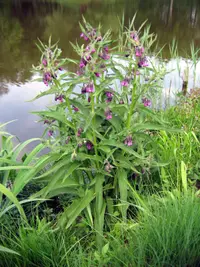
Common comfrey, Symphytum officinale, is a hardy perennial herb known for its large, hairy leaves and clusters of bell-shaped flowers in purple, pink, or creamy white. It forms dense clumps and has deep roots that help it tolerate brief dry spells once established.
The plant is native to Europe and parts of Asia, and it often grows in moist meadows, stream banks, and damp ditches. In gardens, it is usually grown as a robust foliage plant or for compost and mulch use.
Common comfrey grows vigorously and can spread, so it suits larger spaces better than small containers. Understanding how to care for common comfrey starts with providing moist, fertile soil and at least moderate light.

Care Difficulty
Easy Care

Light Preference
Partial Sun

Water Requirements
Regular Water

Temperature Preference
Cold Hardy

Hardiness Zone
3–9

Soil Texture
Loamy, Clay, Organic-rich

Soil pH
Acidic (5.5–6.5), Slightly acidic (6.5–7.0)

Soil Drainage
Moist but well-drained

Fertilization
Minimal (feed rarely)
Scan your plant to receive care tips personalized for your specific plant
Available on iOS and Android
Symphytum officinale grows best in bright, gentle outdoor light with some daily shade.
Symphytum officinale prefers consistently moist but not waterlogged soil.
This hardy perennial tolerates a wide temperature range once established outdoors.
Humidity is rarely a concern for Symphytum officinale grown outdoors in temperate climates.
Symphytum officinale prefers deep, moist, fertile soil that stays evenly damp but not waterlogged.
This species can be grown in containers, but pots must be managed carefully to support its vigorous root system.
Symphytum officinale is a vigorous feeder that benefits from nutrient-rich soil during the main growing season.
Pruning Symphytum officinale is mainly done to control spread, tidy the clump, and refresh new growth.
Common comfrey is usually grown in the ground, so transplanting established clumps is more relevant than repotting.
Symphytum officinale is commonly propagated by root division and root cuttings rather than by seed in gardens.
Symphytum officinale is cold hardy in most temperate climates and needs minimal winter care once established.

Plant Health Check
Not sure what's wrong with your plant? Check your plant's health inside the app.
This species develops a very deep taproot that can reach several meters in loose soil, allowing the plant to access nutrients and moisture well below the reach of most neighboring herbs.
Its roots and leaves contain relatively high concentrations of allantoin, a nitrogen-rich compound involved in cell division that is also used in cosmetic and dermatological products for skin-conditioning purposes.
In the wild, it is strongly associated with nutrient-rich, damp habitats such as riverbanks, ditches, and wet meadows across much of Europe and western Asia, where it can form dense colonies in the herb layer.
Common comfrey played a notable role in traditional European agriculture as a fodder and green manure crop, and historical records from the 18th and 19th centuries describe deliberate planting along field margins and farmyards to supply high-biomass leafy material for livestock and compost heaps.
This species spreads readily through deep, brittle roots and self-seeding. Even small root pieces can resprout. Plant it where permanent growth is acceptable and edge beds or use barriers if you want to limit spread.
Keep your plants happy and healthy with plant identification, disease detection, and easy care guidance.