Timed leaf harvest
Harvest outer leaves frequently once rosettes are 10–15 cm across, leaving the central growth point intact so plants continue to photosynthesize and store energy in the taproot.

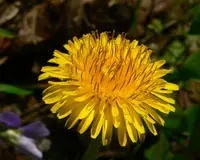
Taraxacum sect. Taraxacum is a group of herbaceous perennials commonly known as dandelions. They form low rosettes of deeply toothed leaves with hollow, milky stems. Bright yellow flower heads mature into spherical seed heads that disperse easily by wind. Plants often appear in lawns, roadsides, and disturbed soils across temperate regions, especially in Europe and North America. These dandelions are highly adaptable and tolerate poor, compacted soils and irregular moisture, which makes them very easy to establish. Full sun, moderate moisture, and well-drained soil support the healthiest growth. Gardeners who want to care for Taraxacum usually manage it more than nurture it, due to its vigorous self-seeding habit.

Care Difficulty
Easy Care

Light Preference
Full Sun

Water Requirements
Moderate Water

Temperature Preference
Cold Hardy

Hardiness Zone
3–9

Soil Texture
Sandy, Loamy, Clay

Soil pH
Slightly acidic (6.5–7.0), Neutral (7.0)

Soil Drainage
Well-drained

Fertilization
Minimal (feed rarely)
Scan your plant to receive care tips personalized for your specific plant
Available on iOS and Android
This common lawn species thrives in open, bright locations with plenty of direct sun.
This deep-rooted perennial prefers moderately moist but not saturated soil.
This hardy perennial tolerates a wide temperature range typical of temperate lawns and fields.
Humidity is rarely a limiting factor for Taraxacum sect. Taraxacum, which thrives in typical outdoor air conditions.
Taraxacum sect. Taraxacum prefers well-aerated, moderately fertile, loose soil that allows its taproot to penetrate deeply.
This species can be grown in containers if the pot is deep enough for its taproot.
Wild-type Taraxacum sect. Taraxacum requires little to no fertilization in typical garden soil.
Taraxacum sect. Taraxacum benefits mainly from light, corrective pruning rather than structural shaping.
This deep-taprooted perennial dislikes disturbance, so transplanting Taraxacum sect. Taraxacum should be minimal and well timed.
Taraxacum sect. Taraxacum is most often propagated by seed rather than by division or cuttings.
This hardy perennial usually needs no special winter care in temperate climates.

Plant Health Check
Not sure what's wrong with your plant? Check your plant's health inside the app.
Most dandelions in Taraxacum sect. Taraxacum set seed without fertilization through a process called apomixis, so each seed is essentially a genetic clone of the mother plant. This allows extremely rapid colonization of disturbed soils such as lawns, cracks in pavement, and roadsides.
Each seed is attached to a parachute-like pappus that acts as a mini flying structure, letting seeds stay aloft for long distances in light wind. Studies show the pappus creates a stable ring-shaped vortex of air, which increases both flight time and dispersal range.
Plants in this section form a strong taproot that can extend deep into the soil and store nutrients and water. Even small root fragments left in the ground can regenerate a full new rosette, which is one reason controlling or growing Taraxacum can be challenging.

Many taxa within Taraxacum sect. Taraxacum reproduce almost entirely without sexual recombination, so what looks like one familiar “dandelion” in a lawn can actually be one of hundreds of microspecies recognized by botanists, differing subtly in leaf shape, bract form, and other small morphological traits.
This species spreads rapidly by wind-dispersed seed and can form dense patches in lawns, beds, and disturbed soil. Regular deadheading before seed set and maintaining a dense turf are the most effective ways to limit spread.
Keep your plants happy and healthy with plant identification, disease detection, and easy care guidance.