Root-zone protection
Maintain a 5–8 cm layer of bark mulch over the root zone, keeping it a few cm away from the trunk, to stabilize soil moisture and temperature and reduce stress during summer heat and winter cold.

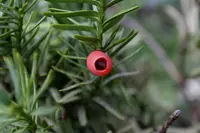
Japanese yew, Taxus cuspidata, is an evergreen conifer often grown as a hedge, foundation shrub, or shaped topiary. It has dense, dark green needles and red, berry-like arils that stand out in cooler seasons.
This species is native to Japan, Korea, northeast China, and parts of Russia, and it adapts well to many temperate landscapes. It grows slowly to moderately and tolerates pruning, which makes it suitable for structured gardens.
Taxus cuspidata is generally hardy and long-lived but sensitive to poor drainage and extreme heat. Understanding how to care for Japanese Yew starts with choosing a well-drained site with moderate light and consistent, but not excessive, moisture.

Care Difficulty
Moderate Care

Light Preference
Partial Shade

Water Requirements
Moderate Water

Temperature Preference
Cold Hardy

Hardiness Zone
4–7

Soil Texture
Sandy, Loamy, Clay

Soil pH
Acidic (5.5–6.5), Slightly acidic (6.5–7.0)

Soil Drainage
Well-drained

Fertilization
Minimal (feed rarely)
Scan your plant to receive care tips personalized for your specific plant
Available on iOS and Android
This shade-tolerant conifer prefers cool, stable light rather than intense, all-day sun.
This species prefers evenly moist, well-drained soil and reacts poorly to standing water.
This cold-hardy conifer thrives in cool to moderate climates with distinct seasons.
Taxus cuspidata handles a wide humidity range and usually needs no special humidity management outdoors.
Taxus cuspidata prefers cool, moist, well-drained soil with stable structure around the roots.
This species can adapt to long-term container growing when given a stable, well-drained setup.
Taxus cuspidata grows slowly and usually needs only light, well-timed feeding in average garden soil.
Taxus cuspidata responds well to controlled pruning that maintains structure and plant health.
Taxus cuspidata is usually grown in the ground, so transplanting is more common than container repotting.
Taxus cuspidata is most often propagated from cuttings, since seed is slow and variable.
Taxus cuspidata is quite cold hardy but benefits from simple winter care, especially when young or container-grown.

Plant Health Check
Not sure what's wrong with your plant? Check your plant's health inside the app.
This species survives winter temperatures below −30°C, which is why it is widely used in landscapes across northern Japan, Korea, northeastern China, and cold parts of North America.
It is usually dioecious, meaning individual plants are either male or female, so only female plants produce the fleshy red arils that surround the seeds.
Mature plants tolerate deep shade under taller trees and can persist for decades in low light, slowly growing until a canopy gap allows faster expansion.

The bright red arils of this species are the only non-toxic part of the plant, and birds eat them and disperse the seeds, but the seeds themselves remain poisonous if crushed and ingested by mammals.
All parts except the red fleshy aril are highly toxic to people and animals if eaten. Dogs, cats, horses, and livestock are especially vulnerable. Ingestion can cause heart problems and sudden death. Avoid planting near grazing areas or play spaces.
Keep your plants happy and healthy with plant identification, disease detection, and easy care guidance.