

Retain Moist Microclimate
Place decaying hardwood in a shaded, wind-sheltered spot and surround it with leaf litter or coarse wood chips to keep the microclimate humid enough for reliable fruiting.

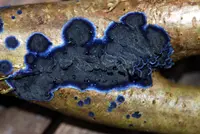
Cobalt crust (Terana caerulea) is a striking blue crust fungus that forms thin, velvety patches on decaying hardwood, especially fallen branches and logs. It is not a traditional houseplant but sometimes interests terrarium and vivarium keepers.
In nature, it occurs across parts of Europe, North America, and Asia, where it helps break down dead wood and recycle nutrients. Its vivid cobalt color appears most clearly in cool, moist, shaded woodland conditions.
Because it depends on consistently damp, decaying wood and stable humidity, it can be challenging to maintain indoors. Anyone wanting to care for Cobalt Crust should focus on cool temperatures, high moisture, and gently shaded conditions.

Care Difficulty
Moderate Care

Light Preference
Shade

Water Requirements
Keep Soil Moist

Temperature Preference
Cool Climate

Hardiness Zone
Unknown

Soil Texture
Loamy, Silty, Organic-rich

Soil pH
Acidic (5.5–6.5)

Soil Drainage
Moist but well-drained

Fertilization
Minimal (feed rarely)
Scan your plant to receive care tips personalized for your specific plant
Available on iOS and Android
This wood-inhabiting fungus prefers cool, shaded woodland light rather than direct sun exposure.
This species develops on consistently moist, decaying wood rather than soil, so moisture management focuses on the substrate.
This fungus thrives in cool to mild conditions and is sensitive to both hard frost and strong heat.
This crust-forming fungus prefers consistently moist, humid microhabitats and reacts quickly to drying conditions.
Terana caerulea develops best on nutrient-rich, decaying wood or woody, organic substrates rather than conventional garden soil.
This species is suitable only for specialized container culture that mimics rotting wood in a shaded, consistently damp environment.
This saprophytic fungus, often called Cobalt Crust, usually obtains enough nutrients from decaying wood and does not need added fertilizer in typical cultivation or observation settings.
Pruning is not a standard practice for Terana caerulea, since it fruits on dead wood rather than growing as a conventional garden plant.
Terana caerulea is best managed by positioning suitable dead wood rather than by traditional repotting or transplanting.
Propagation of Terana caerulea is mostly left to natural spore dispersal rather than controlled home methods.
This wood-inhabiting fungus is generally cold hardy and requires little dedicated winter care in temperate climates.

Plant Health Check
Not sure what's wrong with your plant? Check your plant's health inside the app.
The intense cobalt-blue color of this crust fungus comes from unique fungal pigments rather than the structural coloration (light refraction) seen in many blue animals and plants, which makes its solid blue surface striking even in low light on decaying wood.
This species is a saprotroph, meaning it feeds exclusively on dead wood, helping break down fallen branches and logs and returning locked carbon and nutrients to forest soils in temperate woodlands.
Instead of forming a typical mushroom cap and stem, it produces a thin, flat, paint-like layer tightly attached to the underside of logs, a growth form mycologists describe as resupinate.

Molecular studies have shown that this vivid blue crust fungus is closely related to several other seemingly unremarkable brown and white wood-decaying fungi, illustrating how color alone can be misleading for classifying species without genetic analysis.
This fungus is not suited to typical indoor cultivation. It appears outdoors on very decayed hardwood in cool, damp, shaded sites. Maintaining natural woodland-like conditions is far more realistic than attempting Cobalt Crust indoor care.
Keep your plants happy and healthy with plant identification, disease detection, and easy care guidance.

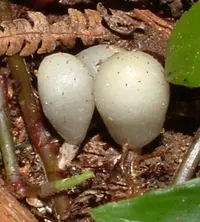
Psilocybe weraroa
Psilocybe weraroa
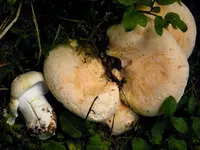
fused polypore
Albatrellopsis confluens
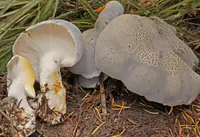
blue knight
Albatrellopsis flettii
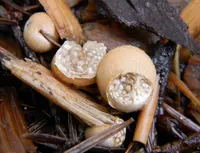
amorphous bird's nest fungus
Nidularia deformis
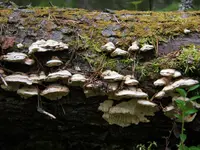
Antrodia heteromorpha
Antrodia heteromorpha
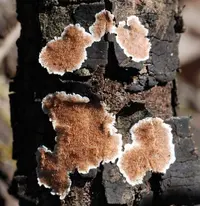
Ochre Spreading Tooth
Steccherinum ochraceum
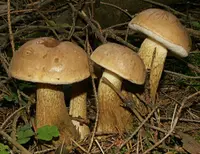
Bitter Bolete
Tylopilus felleus
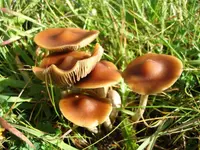
Psilocybe subaeruginosa
Psilocybe subaeruginosa