Stake Early
Install slender stakes or a discreet peony ring in early spring as stems reach 20–30 cm to prevent wind damage and keep the tall, airy growth upright without breaking later in the season.

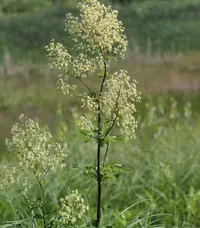
Purple meadow-rue (Thalictrum dasycarpum) is a clump-forming perennial herb native to moist prairies, stream banks, and open woods in North America. It grows upright from slender stems, with fine, divided foliage that gives a delicate, airy look.
In late spring to summer it produces loose clusters of small, fluffy flowers on tall stems, often rising above surrounding plants and adding light texture to planting schemes. The plant prefers consistent moisture, cooler roots, and humus-rich soil.
Gardeners who care for purple meadow-rue usually find it moderate in difficulty, mainly because it dislikes very dry or exposed sites. Once established in a suitable spot, it tends to be long-lived and steady rather than demanding.

Care Difficulty
Moderate Care

Light Preference
Partial Sun

Water Requirements
Regular Water

Temperature Preference
Cold Hardy

Hardiness Zone
3–7

Soil Texture
Loamy, Silty, Organic-rich

Soil pH
Acidic (5.5–6.5), Slightly acidic (6.5–7.0)

Soil Drainage
Moist but well-drained

Fertilization
Minimal (feed rarely)
Scan your plant to receive care tips personalized for your specific plant
Available on iOS and Android
Thalictrum dasycarpum grows best in bright, cool conditions that mimic open woodland edges.
This species prefers consistently moist, cool soil without remaining waterlogged.
This hardy perennial tolerates a wide temperature range but grows most strongly in mild conditions.
This species handles a wide humidity range but grows best with moderately moist air.
Thalictrum dasycarpum prefers consistently moist, deep soil with ample organic matter.
This tall, clumping perennial is manageable in containers if the pot is chosen and placed carefully.
Thalictrum dasycarpum benefits from light, balanced feeding but often manages well in reasonably fertile garden soil.
Thalictrum dasycarpum needs only light, purposeful pruning to stay healthy and tidy.
This species is usually grown in the ground, so focus on careful transplanting rather than frequent repotting.
Thalictrum dasycarpum is commonly propagated by seed or by dividing established clumps.
This plant is cold-hardy in much of its range and generally needs minimal winter attention once established.

Plant Health Check
Not sure what's wrong with your plant? Check your plant's health inside the app.
This species produces loose, airy clusters of flowers whose showy stamens release pollen into the air, relying mainly on wind rather than insects for pollination.
It is naturally found in moist prairies, open meadows, and stream margins across central North America, where it contributes to the vertical structure and diversity of tallgrass plant communities.
Its compound leaves are divided into many small leaflets that give a delicate, fern-like appearance, helping it blend visually with other tall prairie perennials.

Genetic and morphological studies place this species within a group of North American meadow-rues that evolved to occupy open, sunny prairie habitats rather than the shaded woodland niches more typical of many other Thalictrum species.
Poor flowering usually comes from too little light, excess shade from nearby plants, or nutrient‑rich but unbalanced soil high in nitrogen. Division that is too frequent or very young plants can also delay flowering for several seasons.
Keep your plants happy and healthy with plant identification, disease detection, and easy care guidance.