Tradescantia (Andersoniana Group) Care (Tradescantia 'Little Doll')

Tradescantia (Andersoniana Group)

About Tradescantia (Andersoniana Group)

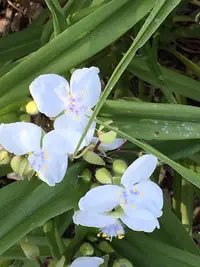
Tradescantia (Andersoniana Group) is a hardy, clump-forming perennial grown mainly for its narrow, grass-like foliage and colorful three-petaled flowers. Tradescantia 'Little Doll' is a compact selection with neat mounds of leaves and abundant small blooms that suit borders, containers, and mixed plantings.

This group traces back to species native to North America, often found in moist meadows and open woodland edges. Plants die back in winter in colder climates and re-sprout strongly in spring.

Growth is generally easy for gardeners who want to learn how to care for Tradescantia (Andersoniana Group). It favors light, moist but drained soil and regular moisture, yet tolerates short dry spells once established.

Main Plant Requirements

Care Difficulty

Easy Care

Light Preference

Bright Indirect Light

Water Requirements

Moderate Water

Temperature Preference

Tropical / Frost Sensitive

Hardiness Zone

9–11

Soil Texture

Loamy, Sandy, Organic-rich

Soil pH

Acidic (5.5–6.5), Slightly acidic (6.5–7.0)

Soil Drainage

Moist but well-drained

Fertilization

Light (every 4–6 weeks)

Get Personalized Care Plan

Scan your plant to receive care tips personalized for your specific plant

Available on iOS and Android

How to Care for the Tradescantia (Andersoniana Group)

This compact perennial prefers bright, gentle light to maintain dense growth and clear leaf markings.

  • Provide 4–6 hours of morning sun or bright, filtered light; eastern exposure or light dappled shade suits Tradescantia (Andersoniana Group) well.
  • Tolerates partial shade, but dense shade leads to weaker stems, elongated growth, and duller foliage over time.
  • In hot summers, protect from intense midday and afternoon sun to prevent leaf scorch, especially in dry or exposed sites.

This plant prefers evenly moist, but not saturated, soil during active growth.

  • Water when the top 2–4 cm of soil feel dry, using enough water so it drains freely from the bed or container without pooling.
  • Reduce watering in cool seasons, allowing the soil surface to stay dry slightly longer while avoiding complete root-zone dryness.
  • Watch for yellowing, soft stems as a sign of overwatering, and crisp, drooping leaves as a sign the plant has been kept too dry.

This hardy perennial handles a range of outdoor temperatures but performs best in mild conditions.

  • Active growth is strongest around 60–75°F (16–24°C), with consistent moisture and protection from drying winds.
  • Established clumps can survive brief drops near 20°F (-7°C), but foliage may die back and re-sprout in spring from the crown.
  • In periods above 85°F (29°C), provide extra shade and soil moisture, as prolonged heat and dryness can cause leaf scorch and stunted growth.

This plant grows best in moderate to slightly elevated humidity and benefits from some protection from very dry indoor air.

  • Aim for 40–60% humidity to keep foliage plump and minimize leaf-tip crisping.
  • It tolerates short dry spells from heating or air conditioning, but prolonged air below 35% often causes brown, papery leaf edges.
  • Increase humidity with grouped plants, a nearby humidifier, or a pebble tray, especially when caring for Tradescantia (Andersoniana Group).

This plant prefers a light, airy, organic-rich mix that drains quickly yet holds some moisture.

  • Use a base of all-purpose potting mix amended with 30–40% perlite or pumice to keep the structure loose and well drained.
  • Aim for slightly acidic to neutral conditions around pH 6.0–7.0, avoiding limy mixes that can cause micronutrient lockout.
  • Include a small portion of fine bark or coconut husk chips to add long-lasting organic matter and improve aeration around the roots.
  • Avoid dense garden soil or peat-heavy mixes that stay wet for days, which increase the risk of stem rot in Tradescantia 'Little Doll'.

This compact trailing plant is very suitable for container growing, including hanging baskets and tabletop pots.

  • Choose a shallow to medium-depth pot that matches its fibrous, spreading roots, so the mix dries evenly between waterings.
  • Use a slightly wider container to allow stems to trail over the rim instead of crowding and matting at the soil surface.
  • Select terracotta or another breathable material if overwatering is likely, as it speeds evaporation and reduces waterlogged conditions.

This compact perennial responds well to light, consistent feeding during active growth.

  • Use a balanced liquid fertilizer (for example 10-10-10) at 1/2 strength every 4–6 weeks from spring to early fall for caring for Tradescantia (Andersoniana Group).
  • Alternatively, apply a thin layer of compost around the root zone in spring to support soil life and steady growth.
  • For containers, a slow-release balanced fertilizer in early spring can supply nutrients for 3–4 months.
  • Stop feeding in late fall and winter when growth slows, to avoid producing weak, soft tissue.

Thoughtful pruning keeps Tradescantia 'Little Doll' compact, flowering well, and free of damaged growth.

  • Best timing is late winter or early spring before strong new growth starts, with light touch-ups after flowering flushes.
  • Remove dead, damaged, or crossing stems down to healthy tissue to reduce disease risk and improve airflow.
  • Shorten leggy or sprawling shoots by 1/3 to encourage branching and a denser, bushier mound.
  • Use clean, sharp hand pruners or scissors and disinfect blades if moving between plants to limit pathogen spread.

Container-grown Tradescantia 'Little Doll' benefits from occasional repotting to prevent root congestion and support steady growth.

  • Check for roots circling the pot base, emerging from drainage holes, or unexplained slow growth as cues it needs more space.
  • Plan to repot every 2–3 years in early spring, just as new shoots begin to grow actively.
  • Choose a pot 2–3 cm wider with drainage and use a free-draining, humus-rich mix, keeping the crown at the same soil level.
  • Water thoroughly after repotting, keep in bright but not harsh sun for 7–10 days, and avoid heavy feeding until new growth resumes.

New plants of Tradescantia 'Little Doll' are most often raised from stem cuttings or division.

  • Take 7–10 cm softwood stem cuttings in late spring or early summer, just below a node, removing lower leaves.
  • Root cuttings in water or a moist, free-draining medium at 65–75°F with bright, indirect light for fastest rooting.
  • Maintain high but not saturated moisture; roots usually form within 1–3 weeks, after which cuttings can be potted individually.
  • For mature clumps, divide in early spring, keeping each division with several shoots and healthy roots, then replant promptly.

This hardy perennial usually needs only modest winter preparation in temperate climates.

  • Tradescantia 'Little Doll' generally tolerates light frosts when grown in the ground, though top growth may die back.
  • In colder regions, apply a 5–8 cm mulch layer around the root zone after the first hard frost, keeping mulch off the crown.
  • For container plants in very cold areas, move pots to a sheltered, frost-free but cool spot to protect roots from deep freezing.

Care Tips

Pinch For Bushiness

Regularly pinch out the soft tips of stems with clean fingers or scissors to keep the plant compact and encourage dense, multi-stemmed growth instead of long, bare runners.

Rejuvenate By Recutting

If stems become leggy, cut them back hard and replant the healthiest 5–8 cm tip cuttings into the same pot to quickly thicken the plant and refresh older, woody growth.

Edge Protection Strategy

When using as a trailing edge plant in mixed containers, position it slightly inside the rim and let only newer stems drape over, which reduces breakage and mechanical damage from handling.

Light-Guided Placement

Rotate the pot by 90° every 1–2 weeks and place trailing stems so they hang toward the light source, which keeps variegation stronger and prevents pale, one-sided growth when growing Tradescantia (Andersoniana Group).

Prevent Splash-Staining

Water at soil level and avoid letting hard tap water run repeatedly over leaves, since mineral deposits can leave dull spots on the foliage; use a squeeze bottle or narrow-spout watering can to direct the flow.

Common Pests and Diseases

Spider mites

This pest causes fine speckling on leaves, dulling of variegation, and fine webbing, especially on undersides of foliage and along stems.

Solution

Rinse foliage thoroughly with lukewarm water, focusing on leaf undersides, then repeat every few days; for heavier infestations use insecticidal soap or a neem oil spray and increase humidity while improving air movement around the plant.

Mealybugs

These insects appear as small white cottony clusters in leaf axils and along stems, leading to distorted new growth and sticky residue.

Solution

Isolate the plant, dab visible insects with cotton swabs dipped in isopropyl alcohol, then wash the plant and follow up with 2–3 applications of insecticidal soap at 7–10 day intervals while checking hiding spots in dense growth.

Aphids

These insects cluster on tender shoot tips and flower stems, causing curling, distortion, and sticky honeydew that can lead to sooty mold.

Solution

Prune heavily infested tips, hose or shower the plant to dislodge insects, then use insecticidal soap or a light horticultural oil spray, ensuring good coverage of soft new growth and repeating as needed.

Leaf spot

This disease produces small brown or purple water-soaked spots on leaves that can merge into larger patches, especially in dense or frequently wet foliage.

Solution

Remove and discard affected leaves, avoid overhead watering, improve airflow, and if spots keep spreading, use a copper-based or other ornamental foliage-safe fungicide following the label while spacing plants to dry quickly after watering.

Botrytis blight

This disease causes soft, grayish-brown patches on leaves and stems, often with fuzzy gray mold on crowded or damaged tissue in cool, humid conditions.

Solution

Cut away all affected tissue back to healthy growth, increase air circulation, reduce leaf wetness, and, if conditions stay humid, apply a general ornamental fungicide labeled for Botrytis while thinning overly dense stems to dry more quickly; these measures support successful growing Tradescantia (Andersoniana Group) in typical home conditions.

Interesting Facts

Compact hybrid origin

This cultivar is a compact hybrid within the Tradescantia Andersoniana Group, bred specifically to produce shorter, denser clumps and a more controlled habit than many older spiderwort garden forms.

Distinctive flower coloring

It is selected for its clear three-petaled violet-blue flowers with contrasting yellow anthers, which can appear in succession over many weeks when the plant is grown in suitable outdoor conditions.

Cool-season performance

This cultivar performs best in mild to cool conditions and often flowers most reliably in late spring to early summer in temperate climates, declining in vigor if exposed to sustained heat and drought.

FAQs about Tradescantia (Andersoniana Group)

This hybrid performs best outdoors in beds or containers where it receives cool conditions and seasonal light changes. It can be kept indoors short term, but long-term Tradescantia (Andersoniana Group) indoor care is more challenging due to light and space needs.

Grow Healthy Plants with Botan Care

Keep your plants happy and healthy with plant identification, disease detection, and easy care guidance.

Botan plant care app — identify plants on mobile

Explore More Plants