Clump Renewal
Every 3–4 years, lift and divide crowded clumps in early spring or early fall to maintain flowering vigor and prevent the center from dying out.

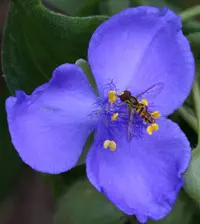
Virginia spiderwort (Tradescantia virginiana) is a hardy, clump-forming perennial grown mainly for its grass-like foliage and three-petaled flowers. It typically forms dense mounds that send up slender, arching stems topped with blue to purple blooms that open in the morning and often close by midday.
This species is native to eastern and central North America, where it grows in meadows, open woodlands, and along roadsides. It adapts well to garden conditions, which makes it relatively straightforward to care for Virginia spiderwort.
The plant tolerates a range of soils and light levels, though it performs best in moist, well-drained soil with partial sun. Its resilience and ability to return each year suit low-maintenance, naturalistic plantings.

Care Difficulty
Easy Care

Light Preference
Partial Sun

Water Requirements
Regular Water

Temperature Preference
Cold Hardy

Hardiness Zone
4–9

Soil Texture
Loamy, Sandy, Clay

Soil pH
Acidic (5.5–6.5), Slightly acidic (6.5–7.0)

Soil Drainage
Moist but well-drained

Fertilization
Minimal (feed rarely)
Scan your plant to receive care tips personalized for your specific plant
Available on iOS and Android
This perennial thrives in locations that balance bright light with protection from harsh extremes.
Moist, well-drained soil supports steady growth and repeat flowering.
This hardy perennial tolerates a wide temperature range but grows best in moderate conditions.
This species grows well in typical outdoor humidity but benefits from slightly moist air in hot, dry periods.
This species prefers loose, moist, well-drained soil that does not stay waterlogged.
This species is suitable for container growing outdoors, especially on patios and balconies.
This native perennial grows well in average soil, but Virginia spiderwort benefits from moderate feeding in lean or heavily used beds.
Pruning Tradescantia virginiana maintains a compact shape and sustains flowering through the season.
This perennial is most often grown in garden beds, where transplanting rather than frequent repotting maintains healthy clumps.
Tradescantia virginiana propagation is commonly done by division, with stem cuttings and seeds as secondary options.
This species is cold hardy in much of the US and usually needs minimal winter care in the ground.

Plant Health Check
Not sure what's wrong with your plant? Check your plant's health inside the app.
Each flower of this species typically opens for only a single morning, often fading or closing by early afternoon as the sun intensity increases, while new flowers open the next day from the same cluster.
The bright yellow stamens are covered with long, hair-like filaments that resemble spider silk and are easily seen with the naked eye, a feature that helps distinguish this species from some related Tradescantia species in its native range.
The cells in the flower buds have been used in genetic and environmental research as a bioindicator for ionizing radiation and certain pollutants, because their chromosomes show visible changes under a microscope after exposure.

This species is native to eastern North American woodlands and prairies and played a role in early colonial gardens, where it was valued as a hardy ornamental that could tolerate both disturbed sites and semi-wild plantings, helping to bridge cultivated spaces with surrounding natural vegetation.
Flowering declines when clumps become crowded or exhausted. Division every 3–4 years, moderate fertilizing, and removing spent stems encourage new buds. Heat, deep shade, or drought also reduce flowering, so maintain even moisture and partial sun exposure.
Keep your plants happy and healthy with plant identification, disease detection, and easy care guidance.