Select Suitable Logs
Use freshly cut, disease-free hardwood logs (such as oak, beech, or maple) 8–15 cm in diameter, as this size gives a good balance between rapid colonization and sustained production when growing Northern Cinnabar Polypore.

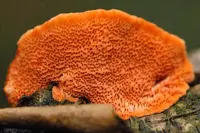
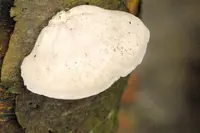
Northern cinnabar polypore (Trametes cinnabarina) is a wood-decay fungus, not a traditional green plant. It forms thin, bracket-like shelves on dead or dying hardwood, with bright orange to red upper surfaces and pale undersides. The fruiting bodies are often clustered and can create striking patches of color on logs and branches.
This species is native to temperate regions of North America and Europe, where it plays an important role in breaking down dead wood. It is not usually grown like an ornamental houseplant, so learning how to care for Northern Cinnabar Polypore focuses on providing suitable wood, moisture, and shade outdoors or in specialized cultivation setups.

Care Difficulty
Easy Care

Light Preference
Partial Shade

Water Requirements
Keep Soil Moist

Temperature Preference
Cool Climate

Hardiness Zone
4–10

Soil Texture
Loamy, Silty, Organic-rich

Soil pH
Acidic (5.5–6.5), Slightly acidic (6.5–7.0)

Soil Drainage
Moist but well-drained

Fertilization
Minimal (feed rarely)
Scan your plant to receive care tips personalized for your specific plant
Available on iOS and Android
This wood-decay fungus thrives on fallen hardwood in shaded to semi-shaded forest conditions rather than direct, open sun.
This fungus depends on consistently moist, but not waterlogged, woody substrate rather than direct watering to its surface.
This species is adapted to temperate climates and fruits well across a broad, cool to mild temperature range outdoors.
Humidity is not a meaningful care factor for this wood-decaying fungus in typical outdoor conditions.
This saprophytic fungus grows on dead hardwood rather than in soil, but a wood-based substrate can be prepared for controlled cultivation.
This species is suitable for container growing only when colonizing hardwood blocks, logs, or bags of supplemented sawdust instead of conventional potting mix.
Trametes cinnabarina is a wood-decay fungus that gains nutrition from its host and does not need added fertilizer in gardens or landscapes.
Pruning is generally unnecessary for Trametes cinnabarina, which naturally forms tiered brackets on dead or declining wood.
Transplanting Northern Cinnabar Polypore is rarely relevant, since this fungus establishes itself on dead wood in situ rather than in containers.
Propagation of Trametes cinnabarina is specialized and usually left to natural spore dispersal on suitable dead hardwood.
Trametes cinnabarina is naturally cold hardy across much of its range and needs no specific winter care in gardens or woodlands.

Plant Health Check
Not sure what's wrong with your plant? Check your plant's health inside the app.
The fruiting bodies of this species show an unusually intense red to orange-red color caused by specific pigments that remain vivid even as the brackets age and dry.
This fungus most often colonizes dead or dying thin branches and twigs of broadleaf trees and shrubs, especially apple and other Rosaceae, rather than large trunks or conifers.
It is a white rot fungus that breaks down both lignin and cellulose in wood, contributing to nutrient recycling in forests and orchards and leaving behind a pale, fibrous residue.

This species often appears in a distorted, cushion-like or irregularly lobed form instead of neat, shelf-shaped brackets, which can make it look more like splashes of solid red wax on the bark than a typical polypore mushroom.
This bracket fungus is best grown outdoors on hardwood logs or stumps. Indoors, it is difficult to maintain the constant fresh air, humidity, and clean wood substrate it needs, so indoor culture is usually unreliable.
Keep your plants happy and healthy with plant identification, disease detection, and easy care guidance.