

Select Proper Host
Harvest or culture the fungus only on well-decayed hardwood logs (preferably oak, maple, or beech) that are free from paint, oil, or chemical treatments to avoid contamination and poor fruiting.

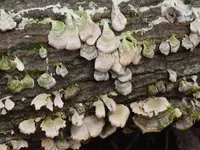
Violet-toothed polypore, Trichaptum biforme, is a wood-decay fungus that commonly forms thin, bracket-like shelves on dead or dying hardwood logs and stumps. It is not a traditional houseplant but a decomposer that helps break down lignin and cellulose in forest ecosystems.
Fruiting bodies are usually small, overlapping tiers with gray to brown upper surfaces and a distinctive violet pore layer underneath when fresh. It is widespread in temperate forests across North America and often appears in large colonies.
Because it depends on dead wood and natural humidity, it is not simple to keep indoors or in gardens. Those who want to learn how to care for violet-toothed polypore need to mimic cool, shaded, consistently moist woodland conditions.

Care Difficulty
Moderate Care

Light Preference
Shade

Water Requirements
Keep Soil Moist

Temperature Preference
Cold Hardy

Hardiness Zone
3–9

Soil Texture
Loamy, Organic-rich

Soil pH
Acidic (5.5–6.5), Slightly acidic (6.5–7.0)

Soil Drainage
Moist but well-drained

Fertilization
Minimal (feed rarely)
Scan your plant to receive care tips personalized for your specific plant
Available on iOS and Android
This wood-decaying fungus thrives in shaded forests with dappled light rather than direct, open sun.
This species relies on natural moisture in decaying wood rather than direct watering.
This fungus is adapted to outdoor woodland climates with cool to mild conditions most of the year.
Humidity is rarely limiting for violet-toothed polypore, which thrives outdoors across broad moisture conditions.
Trichaptum biforme naturally colonizes decaying hardwood rather than mineral soil, so recreate a woody, highly aerated, free-draining substrate.
This species can be grown in containers if a stable, wood-filled habitat is created instead of soil.
This wood-decay fungus typically gains nutrients from its host and usually does not need added fertilizer in cultivation.
Pruning needs for Trichaptum biforme are minimal and focus on safety and appearance rather than plant health.
This species naturally colonizes dead or dying hardwood and is not suited to conventional repotting in containers.
Propagation of Trichaptum biforme is usually left to natural spore dispersal rather than controlled methods.
This species is naturally cold hardy across much of its range and needs no special winter care in outdoor settings.

Plant Health Check
Not sure what's wrong with your plant? Check your plant's health inside the app.
The fruiting body shows a distinctive bicolored underside, with whitish pores near the base and bright violet to lilac hues toward the margin, especially in young brackets. As the fungus ages, the violet colors fade to brownish tones but the layered pattern often remains visible.
This species is a common saprotroph, meaning it feeds on dead organic matter, mainly well-decayed dead branches and logs of hardwood trees such as oak, maple, and birch. It plays a key role in forest nutrient cycling by breaking down lignin-rich wood and helping return bound carbon and minerals to the soil.
The brackets are very thin, tough, and often overlap in dense, shingled tiers on the sides of logs and stumps. Their upper surface usually ranges from gray to brown with fine concentric zoning, which helps distinguish it from thicker, more leathery bracket fungi.

Genetic and microscopic studies have shown that this species produces unusually small, cylindrical spores and distinctive, pointed cystidia on the pore surface, features that helped mycologists separate it from several visually similar crust and bracket fungi in the Polyporales.
This wood-decay fungus colonizes dead logs fairly quickly, often covering small branches within 1–2 seasons. Growth rate depends on wood moisture, species, and size. It continues expanding gradually as long as suitable, undecayed substrate remains.
Keep your plants happy and healthy with plant identification, disease detection, and easy care guidance.

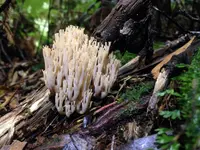
Artomyces austropiperatus
Artomyces austropiperatus
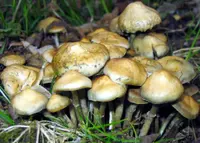
psychedelic ovoid mushroom
Psilocybe ovoideocystidiata
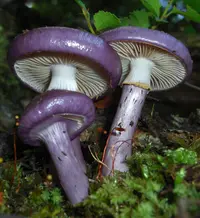
Cortinarius magellanicus
Cortinarius magellanicus
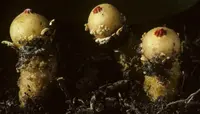
Collared Calostoma
Calostoma lutescens
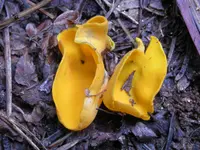
Spring Orange Peel Fungus
Caloscypha fulgens
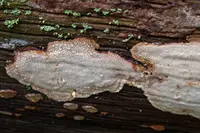
Anthoporia
Anthoporia albobrunnea
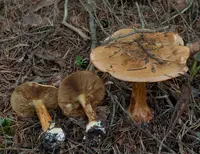
Calonarius sulfurinus
Calonarius sulfurinus
deep root mushroom
Hymenopellis radicata