Host tree selection
Establish the fungus in mixed hardwood stands with oak, beech, or birch, as this mycorrhizal species depends on compatible host tree roots for long-term persistence and fruiting.

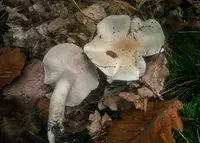
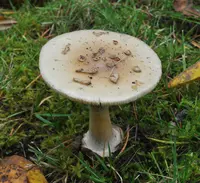
Tricholoma columbetta, commonly called the dove-coloured tricholoma, is a ground-dwelling mushroom rather than a leafy plant. It forms pale, often slightly bluish caps with white gills and a sturdy stem. Caps are usually smooth and dry, with a gentle dome shape that flattens as they mature.
This species occurs naturally in temperate woodlands, especially in Europe, where it grows in soil among leaf litter, often near broadleaf trees. It forms mycorrhizal relationships, meaning it depends on living tree roots, which makes it impossible to grow indoors in pots. Gardeners interested in how to care for dove-coloured tricholoma should focus on maintaining healthy, undisturbed woodland-style habitat with suitable host trees and consistent soil moisture.

Care Difficulty
Hard Care

Light Preference
Partial Shade

Water Requirements
Keep Soil Moist

Temperature Preference
Cool Climate

Hardiness Zone
Unknown

Soil Texture
Loamy, Sandy, Organic-rich

Soil pH
Acidic (5.5–6.5)

Soil Drainage
Moist but well-drained

Fertilization
Minimal (feed rarely)
Scan your plant to receive care tips personalized for your specific plant
Available on iOS and Android
This mycorrhizal mushroom prefers cool, stable woodland light rather than direct, open sun exposure.
This ectomycorrhizal fungus depends on consistently moist, not waterlogged, mineral soil under host trees.
This woodland fungus thrives in cool to mild conditions and is sensitive to both hard frost and strong heat.
This mycorrhizal mushroom does not need controlled air humidity in typical outdoor conditions.
This ectomycorrhizal fungus needs suitable ground conditions for its tree partners rather than a conventional potting substrate.
This woodland ectomycorrhizal species is not suitable for container growing, as it depends on extensive association with living tree roots in open ground.
This wild mycorrhizal fungus usually grows without supplemental feeding, so fertilizer is generally unnecessary for dove-coloured tricholoma.
Pruning is not applicable for Tricholoma columbetta, as it is a wild mushroom rather than a cultivated plant with stems or foliage to shape.
This species is not suited to normal repotting or transplanting, because it depends on a stable mycorrhizal partnership with host tree roots.
Tricholoma columbetta propagation is complex, as it relies on mycorrhizal association with suitable host trees rather than standard garden techniques.
No specific winter care is needed, as this woodland fungus persists underground as mycelium and is naturally adapted to local seasonal conditions.

Plant Health Check
Not sure what's wrong with your plant? Check your plant's health inside the app.
The cap is characteristically pale whitish to dove-grey, often with subtle bluish or greenish tints and fine fibrils, which helps distinguish it from many darker Tricholoma species in mixed woodlands.
This ectomycorrhizal fungus forms symbiotic root partnerships mainly with oaks (Quercus spp.), exchanging mineral nutrients and water for sugars produced by the tree, and is therefore usually found near its host trees on acidic to neutral soils.
Unlike several toxic white Tricholoma species that have distinctly bitter or unpleasant-tasting flesh, this species typically has white, crowded gills and a mild to slightly floury taste and smell, which mycologists use as identification characters rather than as edibility advice.
This species is generally regarded as an edible wild mushroom, but correct identification is critical. It can be confused with toxic white Tricholoma species. Only eat specimens confirmed by an experienced mycologist and always cook thoroughly before consumption.
Keep your plants happy and healthy with plant identification, disease detection, and easy care guidance.