Host tree selection
Establish this ectomycorrhizal fungus only near compatible hosts such as beech, oak, pine, or spruce, and avoid planting under isolated ornamental trees with heavily disturbed or compacted soil.

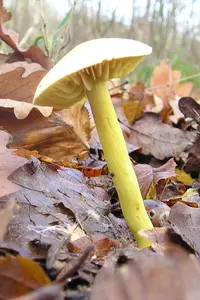
Sulphur Knight, Tricholoma sulphureum, is not a plant but a woodland mushroom known for its strong sulfur-like smell and bright yellow color. It forms sturdy, fleshy caps and short, thick stems, usually in groups.
This species naturally occurs in temperate forests, often under beech or oak, where it forms mycorrhizal associations, meaning it exchanges nutrients with tree roots. It is considered inedible and is mainly of interest to foragers and fungi enthusiasts rather than home growers.
Because it depends on complex soil fungi and tree partners, it is very difficult to cultivate intentionally. Most people do not try to care for Sulphur Knight and instead simply learn to recognize and avoid it in the wild.

Care Difficulty
Hard Care

Light Preference
Partial Shade

Water Requirements
Keep Soil Moist

Temperature Preference
Cool Climate

Hardiness Zone
Unknown

Soil Texture
Loamy, Organic-rich

Soil pH
Acidic (5.5–6.5)

Soil Drainage
Moist but well-drained

Fertilization
Minimal (feed rarely)
Scan your plant to receive care tips personalized for your specific plant
Available on iOS and Android
This woodland fungus grows best in low to moderate light that mimics a shaded forest floor.
This mycorrhizal fungus depends on consistently moist, well‑drained soil rather than direct surface watering.
This species fruits best in cool to mild conditions typical of temperate woodlands.
Humidity management is not relevant for Tricholoma sulphureum, which lives as a woodland fungus rather than a houseplant.
Tricholoma sulphureum grows in the ground under trees and is not suited to potting mixes or typical houseplant substrates.
This species is not suitable for container growing, since it requires living tree roots and stable woodland soil conditions to complete its life cycle.
This wild ectomycorrhizal fungus does not need fertilizing in gardens or containers, as it relies on a nutrient exchange with host tree roots.
Tricholoma sulphureum does not require pruning, since the visible mushroom is only the fruiting body of a larger underground organism.
Transplanting is rarely appropriate because this fungus depends on a stable symbiosis with specific tree roots.
Propagation of this mushroom is specialized and not practical for typical home growers, as it requires establishing an ectomycorrhizal partnership with host trees.
This species is naturally cold hardy in many temperate forests and does not need special winter care in outdoor settings.

Plant Health Check
Not sure what's wrong with your plant? Check your plant's health inside the app.
Mature fruiting bodies release a strong, penetrating smell often compared to coal gas, tar, or rotten eggs, which helps distinguish this poisonous species from edible yellow mushrooms in the same habitats.
The cap, gills, and stem share a uniform intense sulfur-yellow color, an unusually consistent pigmentation among woodland agarics and a visual cue often associated with toxicity to vertebrates.
This species forms ectomycorrhizal partnerships with broadleaf trees, especially European beech, exchanging mineral nutrients from the soil for sugars produced by the tree through photosynthesis.

Toxic compounds in this fungus can cause delayed-onset gastrointestinal poisoning, where symptoms such as nausea, vomiting, and abdominal cramps often appear several hours after eating, which has historically led to misattribution of the cause of illness.
This bright yellow mushroom is considered inedible and often treated as poisonous due to strong sulfurous odor and reports of gastrointestinal upset. It must not be eaten or taste-tested, even in small amounts.
Keep your plants happy and healthy with plant identification, disease detection, and easy care guidance.