Substrate rotation
Rotate or replace the fruiting substrate every 2–3 flushes to prevent nutrient depletion and buildup of competing fungi, which helps maintain consistent yields when growing Grey Knight.

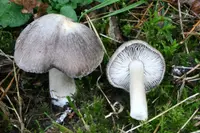
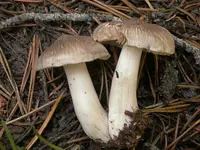
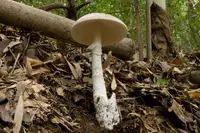
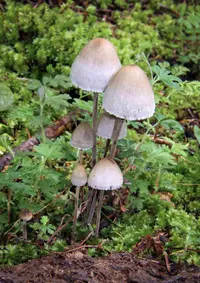
Tricholoma terreum, commonly called Grey Knight, is a small, ground-dwelling mushroom, not a leafy houseplant. It produces gray, fibrous caps with pale gills and a slender stem, usually emerging in loose groups.
This species is typically found in temperate coniferous forests, especially under pine trees, where it forms mycorrhizal partnerships with roots and helps with nutrient exchange.
Cultivation at home is challenging because it depends on living tree partners and specific soil microbe communities. Those who wish to care for Grey Knight should understand it cannot be grown like standard potted plants and is best appreciated in suitable woodland habitats.

Care Difficulty
Hard Care

Light Preference
Partial Shade

Water Requirements
Keep Soil Moist

Temperature Preference
Cool Climate

Hardiness Zone
Unknown

Soil Texture
Loamy, Silty, Organic-rich

Soil pH
Acidic (5.5–6.5), Slightly acidic (6.5–7.0)

Soil Drainage
Moist but well-drained

Fertilization
Minimal (feed rarely)
Scan your plant to receive care tips personalized for your specific plant
Available on iOS and Android
This forest mushroom prefers dappled woodland light rather than direct, open sun.
This ectomycorrhizal mushroom relies on consistently moist, not waterlogged, soil around host tree roots.
This woodland fungus fruits best in cool to mild conditions typical of autumn forests.
Humidity plays only a minor role for Tricholoma terreum compared with suitable host trees and soil conditions.
Tricholoma terreum needs a specific outdoor soil environment rather than a standard potting medium.
This species is not suitable for container growing because it requires a living tree root system and stable woodland soil conditions for mycorrhizal association.
This woodland mushroom associates with trees and does not need routine fertilizer when growing in natural soil.
Tricholoma terreum does not require conventional pruning because it is a mycorrhizal mushroom rather than a garden shrub or houseplant.
This species is typically not suited to container culture, so any management focuses on transplanting associated trees or adjusting the habitat rather than the fungus itself.
This mycorrhizal fungus is not realistically propagated at home, since it depends on complex root partnerships with suitable host trees.
In suitable climates this woodland fungus overwinters naturally with its host trees and does not need targeted winter care from gardeners.

Plant Health Check
Not sure what's wrong with your plant? Check your plant's health inside the app.
Young fruiting bodies have a finely fibrous, grey cap that often becomes more radially streaked and slightly darker toward the center as they mature, which helps distinguish them from uniformly colored grey brittlegills and waxcaps in the same habitat.
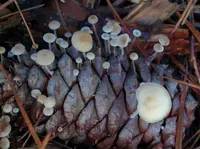
This species forms ectomycorrhizal partnerships with pines, especially in dry, sandy or well-drained soils, and often appears in large troops or arcs on the forest floor from late summer to late autumn.
Although historically listed in many European field guides as edible, later toxicological reports linking similar species to muscle damage created enough uncertainty that many modern mycologists now recommend treating it as a species to avoid for consumption.

Molecular studies have shown that collections once all called Tricholoma terreum actually represent a complex of closely related, look-alike species, which means older field records and culinary reports may refer to several different taxa rather than a single, well-defined mushroom.
This mushroom is traditionally considered edible but has been linked to muscle toxicity when eaten repeatedly or in large amounts. Many modern guides recommend avoiding consumption and choosing better-studied, safely identified edible species instead.
Keep your plants happy and healthy with plant identification, disease detection, and easy care guidance.