Mulch For Cool Roots
Apply a 5–8 cm layer of fine shredded bark or composted leaf mold around the clump each spring to keep roots cool, conserve moisture, and suppress weeds without covering the crowns themselves.

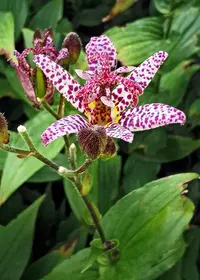
Tricyrtis formosana, commonly called toad lily, is a shade-loving perennial grown mainly for its unusual, orchid-like flowers. It forms clumps of arching stems with lance-shaped leaves. Late-season blooms are typically white to pale lavender, heavily spotted with purple, and appear along the stems rather than in big clusters. In gardens it brings color and interest to shady borders when many other plants are fading. It comes from woodland habitats in East Asia, so it prefers cool conditions, even moisture, and humus-rich soil. These traits make it moderately easy to care for toad lily if the site does not dry out or overheat.

Care Difficulty
Moderate Care

Light Preference
Partial Shade

Water Requirements
Keep Soil Moist

Temperature Preference
Cold Hardy

Hardiness Zone
4–9

Soil Texture
Loamy, Silty, Organic-rich

Soil pH
Acidic (5.5–6.5), Slightly acidic (6.5–7.0)

Soil Drainage
Moist but well-drained

Fertilization
Light (every 4–6 weeks)
Scan your plant to receive care tips personalized for your specific plant
Available on iOS and Android
This shade-loving perennial performs best in dappled woodland-style light.
Moist, cool, but well-drained soil is essential for healthy growth.
This hardy perennial prefers cool to mild conditions with protection from extremes.
This species prefers consistently moist air but adapts to typical home humidity if soil moisture is stable.
This woodland perennial prefers moist, airy soil rich in organic matter and low in salts.
This species grows well in containers when moisture and shade are managed carefully.
Tricyrtis formosana responds well to light, consistent feeding during the active growing season.
Pruning Tricyrtis formosana is light and focused on keeping clumps healthy and flowering well.
This species is usually grown in the ground, so focus on careful transplanting rather than frequent repotting.
Multiplying Tricyrtis formosana is most reliable through division, with seeds and cuttings as secondary options.
This perennial is fairly cold hardy but benefits from simple winter care in colder regions.

Plant Health Check
Not sure what's wrong with your plant? Check your plant's health inside the app.
This species is native to shaded, moist mountain forests of Taiwan, where it grows along stream banks and rocky slopes under deciduous and evergreen trees.
It flowers in late summer to fall, providing nectar and pollen for bees and other insects at a time when many woodland plants have already finished blooming.
Its white to pale lavender tepals are densely spotted with purple dots, a pattern thought to help guide insect pollinators toward the flower’s reproductive structures.

The flowers of this species are held on upright, often branching stems that can continue to produce new buds sequentially along the stem, so a single clump can stay in ornamental bloom for many weeks in late season when few other shade perennials are flowering.
Lack of flowers often comes from too much shade, excess nitrogen fertilizer, or stress from drought or heat. Stable moisture, moderate feeding, and avoiding disturbance of the clumps usually improves blooming over the next season.
Keep your plants happy and healthy with plant identification, disease detection, and easy care guidance.