Anchored Containers
In ponds or large tubs, place the root mass inside a heavy aquatic basket with coarse substrate and add stones on top so the plant remains stable as it gains height and does not topple in wind or current.

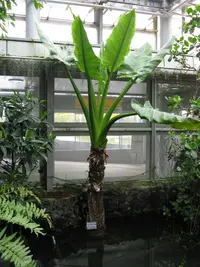
Water banana, Typhonodorum lindleyanum, is a large aquatic plant native to Madagascar and nearby islands. It grows in shallow, still or slow-moving freshwater habitats such as marshes and river edges. The plant forms thick, cane-like stems with huge paddle-shaped leaves that give it a bold, tropical look. In suitable conditions it develops striking, arum-like flower structures followed by clusters of banana-shaped fruits. Its strong need for warm temperatures, abundant water, and stable aquatic conditions makes it challenging outside specialized ponds or large indoor water features. Understanding how to care for Water Banana starts with providing constant moisture, rich organic substrate, and bright light without harsh exposure.

Care Difficulty
Hard Care

Light Preference
Full Sun

Water Requirements
Aquatic

Temperature Preference
Tropical / Frost Sensitive

Hardiness Zone
11–12

Soil Texture
Loamy, Silty, Organic-rich

Soil pH
Acidic (5.5–6.5), Slightly acidic (6.5–7.0)

Soil Drainage
Waterlogged tolerant

Fertilization
Light (every 4–6 weeks)
Scan your plant to receive care tips personalized for your specific plant
Available on iOS and Android
This large aquatic plant thrives in strong light typical of open, tropical wetlands.
This species is a true aquatic or semi-aquatic plant that prefers continuously saturated conditions.
This tropical species needs consistently warm conditions and does not tolerate frost.
This swamp aroid needs very high, constant humidity to grow well.
Typhonodorum lindleyanum is adapted to permanently wet, organic-rich substrates rather than conventional potting soil.
This species can be grown in very large, heavy containers placed in ponds or water features.
This large aquatic species benefits from moderate feeding in containers or nutrient-poor ponds, but excessive fertilizer can harm water quality.
Typhonodorum lindleyanum usually needs only light maintenance pruning to stay healthy and tidy.
This large marsh plant is typically transplanted in ponds or boggy beds rather than kept long-term in small containers.
Propagation of Typhonodorum lindleyanum is possible but slower and usually managed by experienced growers.
This tropical marsh plant is frost-sensitive and needs protection in cooler climates during winter.

Plant Health Check
Not sure what's wrong with your plant? Check your plant's health inside the app.
This species is a large aquatic aroid native to Madagascar, forming massive clumps along slow rivers and lakeshores with thick, spongy leaf stalks adapted to support the plant in waterlogged conditions.
Its large, fibrous fruits contain seeds that are dispersed by water; they can float and are carried by currents, helping the species colonize new riverbanks and marshy areas.
In the wild it grows in sunny, permanently wet habitats, often rooted in shallow water or saturated mud, and plays a structural role in stabilizing banks and providing shelter for aquatic organisms.

In parts of Madagascar, the buoyant, fibrous leaf stalks and other tissues of this plant have been traditionally used as a lightweight material for rafts and flotation devices, making practical use of its highly spongy, air-filled structure.
This species is relatively fast-growing in warm, wet conditions, often putting on 30–90 cm of height per year. Growth slows in cooler weather or if water, nutrients, or root space are limited.
Keep your plants happy and healthy with plant identification, disease detection, and easy care guidance.