Rocky Placement
Tuck plants into shallow crevices in rocks, broken concrete, or stone walls with minimal substrate to mimic natural cliff habitats and keep roots cool and well aerated.

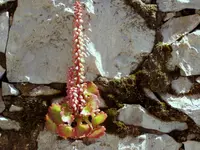
Wall pennywort, Umbilicus rupestris, is a small succulent perennial that often grows from cracks in walls, rocks, and old stonework. It forms loose rosettes of round, peltate leaves with a central dimple and sends up slender spikes of small, bell-like flowers.
This species is native to western and southern Europe, where it thrives in cool, damp, shaded crevices. Its drought-tolerant, fleshy leaves make it relatively resilient, but it needs protection from hot, dry, exposed sites.
Because it prefers moist, well-drained, rocky substrates and mild conditions, it is easiest in climates with cool summers. Understanding how to care for Wall Pennywort starts with providing shade, steady moisture, and a free-draining, gritty soil mix.

Care Difficulty
Moderate Care

Light Preference
Partial Shade

Water Requirements
Moderate Water

Temperature Preference
Cool Climate

Hardiness Zone
7–9

Soil Texture
Sandy, Loamy, Rocky

Soil pH
Slightly acidic (6.5–7.0), Neutral (7.0)

Soil Drainage
Well-drained

Fertilization
Minimal (feed rarely)
Scan your plant to receive care tips personalized for your specific plant
Available on iOS and Android
This rock-dwelling succulent prefers bright, gentle light rather than intense, all-day sun.
This species prefers drying cycles and is sensitive to prolonged moisture around its roots.
This plant is adapted to mild, rocky climates with cool, not harsh, seasonal changes.
This species handles typical indoor humidity but prefers slightly moist air.
This plant prefers mineral, sharply drained substrates that mimic rocky crevices.
This species is well suited to container growing when drainage and depth are managed carefully.
This rock-dwelling succulent needs very light feeding, and many established plants grow acceptably with no fertilizer.
Umbilicus rupestris needs only minimal pruning to keep rosettes tidy and healthy.
This species prefers to stay undisturbed, so repotting or transplanting is infrequent and should be done with care.
Umbilicus rupestris is commonly propagated from seed or by carefully moving self-sown seedlings rather than by cuttings.
This rock succulent is fairly cold hardy and usually needs little specific winter care in mild to moderate climates.

Plant Health Check
Not sure what's wrong with your plant? Check your plant's health inside the app.
This species naturally colonizes vertical rock faces, cliffs, old walls, and stone bridges, anchoring its roots in tiny crevices where very little soil accumulates.
Its rounded, peltate leaves (where the stalk attaches near the center of the blade) have succulent tissue that stores water, allowing the plant to tolerate intermittent drought on exposed masonry and rocks.
In mild climates the plant often grows and produces its fleshy leaves in the cooler, wetter months, then may partially die back or aestivate during the drier heat of summer.

The traditional English name "navelwort" refers to the distinct central depression in each leaf, which resembles a human navel and is a direct visual consequence of the petiole inserting near the leaf center rather than at the margin.
This species spreads slowly by seed and short stolons, usually forming small patches rather than large carpets. In typical rock crevices or wall joints it is easy to keep in check with periodic thinning.
Keep your plants happy and healthy with plant identification, disease detection, and easy care guidance.