Water Table Setup
Place the pot in a shallow tray with 1–2 cm of low-mineral water so the medium stays evenly wet while allowing the crown to sit just above the standing water line.

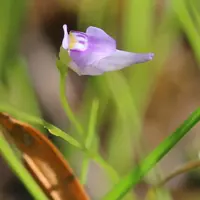
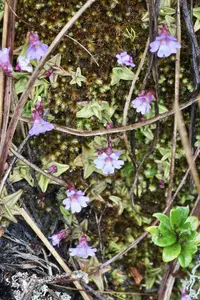
Bladderwort (Utricularia caerulea) is a small carnivorous plant that naturally grows in nutrient-poor, wet habitats such as bogs, marshes, and wet sandy soils. It uses tiny underwater or soil-level bladder traps to capture microscopic prey, which helps supply nutrients missing from its environment.
The plant often forms low, delicate foliage with fine leaves and sends up thin stems topped with small, usually blue to violet flowers. It stays compact, which suits small containers or specialized carnivorous plant setups.
This species can be challenging for beginners, mainly because it demands consistently moist, low-mineral conditions and good light. Anyone wanting to learn how to care for bladderwort should be prepared to maintain stable moisture and avoid regular potting soil or fertilizers.

Care Difficulty
Hard Care

Light Preference
Partial Sun

Water Requirements
Aquatic

Temperature Preference
Tropical / Frost Sensitive

Hardiness Zone
10–12

Soil Texture
Sandy, Peaty, Organic-rich

Soil pH
Strongly acidic (4.5–5.5)

Soil Drainage
Waterlogged tolerant

Fertilization
Minimal (feed rarely)
Scan your plant to receive care tips personalized for your specific plant
Available on iOS and Android
This small carnivorous plant prefers bright, gentle light similar to open, moist grasslands.
This species needs constantly wet conditions that mimic shallow bogs or seepage areas.
This tropical bladderwort grows best in consistently warm, frost-free conditions.
This species prefers consistently high humidity to thrive in cultivation.
This carnivorous plant grows best in very soft, nutrient-poor, consistently wet media rather than conventional potting soil.
This species is suitable for container culture when moisture control is precise.
This small carnivorous bladderwort gains most nutrients from trapped prey and usually needs no added fertilizer in typical indoor culture.
Pruning Utricularia caerulea is minimal and mainly helps keep the mat tidy and flowering well.
Repotting Utricularia caerulea focuses on refreshing the low‑nutrient medium rather than giving more root room.
Utricularia caerulea is most commonly propagated by division of its fine stolons rather than by seed.
Winter care depends on climate, as this species dislikes hard frost and is best treated as a tender plant in cold regions.

Plant Health Check
Not sure what's wrong with your plant? Check your plant's health inside the app.
This species carries tiny underwater bladder traps on its finely divided leaves that actively suck in microinvertebrates when trigger hairs are touched, using a rapid vacuum mechanism powered by stored osmotic pressure.
It produces small, usually pale blue to lilac snapdragon-like flowers on thin, upright stalks that rise well above the leaf mat and are pollinated by small insects in its native Asian habitats.
Populations often grow in shallow, seasonally wet depressions, rice fields, and seepage areas, tolerating cycles of flooding and brief drying by concentrating growth and flowering during the wet period.

In some regions this species forms extensive, almost continuous mats over wet sand or mud, creating a thin living carpet in which most biomass is only a few millimeters thick, yet still supporting a full cycle of carnivory, flowering, and seed production.
Lack of flowers usually comes from low light intensity, water that is too nutrient-rich, or unstable temperatures. Provide bright conditions, low-mineral water, and avoid frequent disturbance of the pot or substrate to support reliable flowering.
Keep your plants happy and healthy with plant identification, disease detection, and easy care guidance.