Seasonal Water Depth
Adjust water depth through the year by keeping plants in 10–20 cm of water in spring and fall, then allowing slightly deeper water in midsummer to buffer temperature swings and reduce stress on the traps.

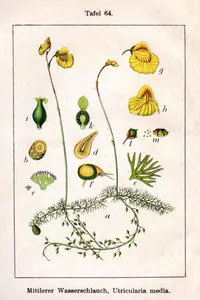
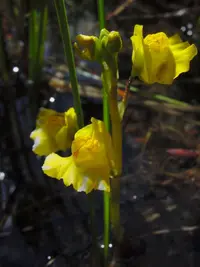
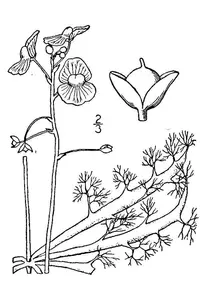
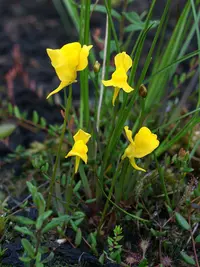
Flatleaf bladderwort, Utricularia intermedia, is a small, carnivorous aquatic plant found in nutrient-poor lakes, ponds, and bogs across cooler regions of the Northern Hemisphere. It floats or grows loosely anchored in shallow water, with fine, threadlike leaves bearing tiny bladder traps that capture small aquatic animals.
The plant lacks true roots and relies on its traps for extra nutrients, which makes it sensitive to water quality and disturbance. It can be challenging to grow in cultivation, as it needs consistently clean, low-nutrient, acidic water and stable conditions. Those who want to learn how to care for flatleaf bladderwort should understand its bog and pond habitat before attempting it at home.

Care Difficulty
Hard Care

Light Preference
Full Sun

Water Requirements
Aquatic

Temperature Preference
Cold Hardy

Hardiness Zone
3–7

Soil Texture
Peaty, Organic-rich, Silty

Soil pH
Strongly acidic (4.5–5.5)

Soil Drainage
Waterlogged tolerant

Fertilization
Minimal (feed rarely)
Scan your plant to receive care tips personalized for your specific plant
Available on iOS and Android
This semi-aquatic carnivorous species needs strong light to maintain healthy growth and trap production.
This bog and pond-edge species requires constant, mineral-poor water rather than intermittent soil drying.
This temperate carnivorous aquatic adapts to cool conditions but still has clear thermal limits.
This semi-aquatic carnivorous species needs very high, stable humidity to stay healthy in culture.
This species grows best in saturated, nutrient-poor, organic media that mimic shallow bog or fen margins.
This species can be grown in containers if they function as small bog or aquatic trays rather than standard pots.
This aquatic carnivorous species gathers most nutrients from prey and usually needs no added fertilizer in cultivation.
Pruning Utricularia intermedia focuses on hygiene and maintaining open, healthy growth in the water or bog container.
Transplanting this semi-aquatic species is mainly needed when reshaping ponds or renewing bog containers.
Utricularia intermedia is most often propagated vegetatively through division and stem sections rather than seed.
This cold-hardy aquatic bladderwort forms overwintering turions, so outdoor stands usually need minimal winter care in temperate climates.

Plant Health Check
Not sure what's wrong with your plant? Check your plant's health inside the app.
This species forms two distinct kinds of underwater bladder traps: larger ones on stolons buried in sediment for invertebrates living in the substrate, and smaller ones on free shoots in the water column, an adaptation not seen in all related species.
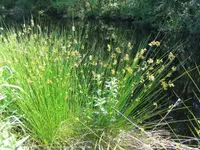
In the wild, it is typically found in nutrient-poor, soft, slightly acidic waters of peat bog pools, shallow lakes, and slow channels, reflecting a strong adaptation to low-mineral, oligotrophic habitats.
Populations can shift between more free-floating, water-column growth and more anchored, sediment-inhabiting growth depending on depth, water movement, and substrate, giving this plant a flexible ecological niche compared with several other bladderworts.

In parts of its range, especially in Central Europe, this species has declined enough to be regionally red-listed or legally protected due to wetland drainage, peat extraction, and eutrophication, making it an indicator for the conservation status of intact, low-nutrient bog and fen systems.
Poor flowering usually comes from low light, unstable water levels, or nutrient-rich water that reduces carnivory. Provide bright conditions, cool to mild water temperatures, and low-mineral, low-nutrient water to support healthy trap development and flower production.
Keep your plants happy and healthy with plant identification, disease detection, and easy care guidance.