Use rainwater trays
Stand the pot in a shallow tray of rainwater or RO water to keep the medium constantly moist, but empty and refresh the tray every 2–3 days to prevent stagnation and bacterial buildup.

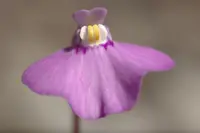
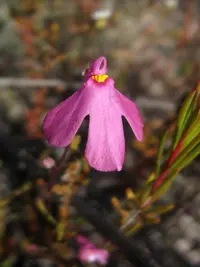
Utricularia uniflora is a small, semi-aquatic carnivorous plant in the bladderwort family. It forms fine, threadlike leaves with tiny underwater traps that capture microorganisms. Delicate, pale flowers rise above the water or saturated substrate, giving the plant a light, airy look despite its predatory habit. It naturally occurs in nutrient-poor, wet habitats such as bogs and shallow pools in parts of Australia. The species can be demanding in cultivation because it needs consistently clean, soft water and very low-nutrient conditions. Understanding how to care for Utricularia uniflora starts with replicating its bright, cool, and wet natural environment as closely as possible.

Care Difficulty
Hard Care

Light Preference
Partial Shade

Water Requirements
Aquatic

Temperature Preference
Tropical / Frost Sensitive

Hardiness Zone
Unknown

Soil Texture
Peaty, Organic-rich

Soil pH
Strongly acidic (4.5–5.5)

Soil Drainage
Waterlogged tolerant

Fertilization
Minimal (feed rarely)
Scan your plant to receive care tips personalized for your specific plant
Available on iOS and Android
This small carnivorous species needs bright but gentle light that mimics open, boggy habitats.
This species is adapted to very wet, low-nutrient conditions and should never dry out completely.
This plant prefers mild, frost-free conditions with stable temperatures for steady growth.
This small carnivorous species needs consistently high humidity to grow well in cultivation.
This carnivorous plant requires a very low-nutrient, airy, and constantly moist medium rather than standard potting soil.
This species is well suited to container culture, especially in trays or shallow bowls.
This carnivorous species gains most nutrients from captured prey, so Utricularia uniflora needs little to no conventional fertilization.
This plant needs only light pruning to keep the colony tidy and flowering well.
This delicate bladderwort dislikes disturbance, so repotting or transplanting should be infrequent and gentle.
This species is usually propagated vegetatively, since seed production and germination are less reliable in home conditions.
This is a frost-sensitive species that needs consistently mild, wet conditions through winter.

Plant Health Check
Not sure what's wrong with your plant? Check your plant's health inside the app.
This small carnivorous species is naturally restricted to cool, humid coastal regions of southeastern Australia, especially New South Wales and Tasmania, where it often grows in seepage areas and wet rock faces influenced by oceanic climates.
Unlike many other bladderworts that live submerged in water, this species usually grows as a terrestrial or lithophytic plant in thin, constantly moist substrates such as wet moss, peaty sands, or shallow soil pockets on rocks.
The plant has very fine, filamentous vegetative structures instead of broad leaves, with most of its biomass hidden in the substrate, so the delicate flowers are usually far more visible than the rest of the plant when in bloom.

The tiny underwater or soil-embedded bladders of this species use a rapid active suction mechanism, generating negative pressure to pull in small prey such as protozoa and tiny invertebrates in a fraction of a second, making it one of the fastest-moving structures in the plant kingdom.
Lack of flowers often comes from insufficient light intensity, water that is too mineral-rich, or temperatures outside its preferred mild range. Stable conditions, low-mineral water, and a consistent wet substrate usually improve flowering over several months.
Keep your plants happy and healthy with plant identification, disease detection, and easy care guidance.