


red huckleberry Identification (Vaccinium parvifolium)

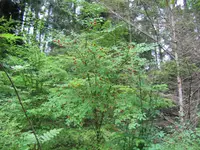
Recognize red huckleberry by its small, alternate oval leaves on bright green, sharply angled twigs, often with a sparse, upright branching pattern. Plants usually form a many-stemmed shrub or small tree.

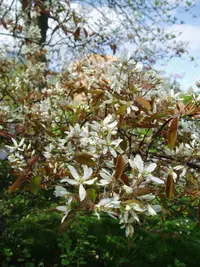
The flowers hang singly from leaf axils and are narrow, urn-shaped tubes about 1/4 inch (6 mm) long.

Vaccinium parvifolium Identification

Identify Your Plant with Botan

Upload a clear photo to check your plant identification with Botan.

Clear images work best. Avoid photos taken too close or too far away

Check the plant’s twiggy shape, leaf placement, flowers, and berries.

  • Shrub is airy and many-branched, often with stiff green branchlets and a loose, upright outline.
  • Leaves are small, thin, and alternate, usually oval to elliptic, about 1/2-1 1/2 inches (1-4 cm) long, with smooth edges.
  • Flowers hang singly from the leaf axils and are small, urn-shaped tubes, usually pink to greenish.
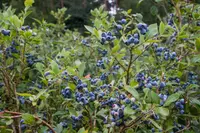
  • Berries are bright red, round, and often slightly translucent, about 1/4 inch (6 mm) wide.

Look for the combination of tiny alternate leaves, hanging urn-shaped flowers, and clear red berries.

Vaccinium parvifolium shows clear visual shifts from sparse youth to flower and fruit display.

  • Juvenile plant: Young shrubs are thin and open, with green angled twigs and widely spaced small oval leaves, giving a delicate, airy outline.
  • Mature plant: Older plants form a taller, fountainlike shrub or small tree, often 3-12 feet (0.9-3.7 m) high, with arching branchlets and a more woody framework.
  • Flowering stage: Flowers hang singly or in small clusters from leaf axils; the pink, urn-shaped corollas make branch tips look dotted rather than leafy.
  • Fruiting stage: After flowering, bright red translucent berries replace the flowers along slender green twigs, standing out more clearly than the earlier nodding blooms.

In spring, Vaccinium parvifolium shows small urn-shaped flowers, followed by bright red berries in summer that remain a strong field mark as they ripen. In fall, the leaves often turn yellow to red before dropping. Winter exposes the plant’s green, sharply angled twigs and reddish bark, which help with recognition when it is bare.

A few western shrubs can be mistaken for red huckleberry at a glance.

evergreen huckleberry(Vaccinium ovatum)

It shares small oval leaves and berry-like fruit. The quickest difference is foliage texture: evergreen huckleberry has thicker, glossy, finely toothed leaves, while V. parvifolium has thinner, deciduous leaves with smoother edges.

blue huckleberry(Vaccinium membranaceum)

Both are huckleberries with similar simple leaves and rounded berries. Blue huckleberry usually has blue to black fruit and larger leaves, often 1 to 3 inches (2.5 to 7.5 cm) long; V. parvifolium has bright red berries and smaller leaves.

Vaccinium parvifolium is native to the Pacific coast of North America, from southeastern Alaska through British Columbia and Washington to Oregon and California. That range is useful because it is a regional species, not a widespread inland blueberry. It is most often found in moist conifer forests, rainforest margins, streamside woods, and on old stumps or nurse logs, mainly from low elevations to montane forest zones. Seeing it in shaded coastal woodland helps narrow the identification.

Does Your Plant Match?

Use Botan to compare a photo and help confirm the plant, which can save time before you label it or look up details.

FAQ

Young stems are notably bright green, slender, and smooth, often angled or slightly ridged. Older wood turns grayish to brown. This green twig color is one of the quickest clues when identifying red huckleberry.

More Plant Identification Guides

One Photo. More About Your Plant.

Identify a plant from a photo with Botan, then review its profile, care information, and common problems.

Botan app identifying a plant from a photo
Best Time to Water Grass in Summer – Lawn Watering Tips

5 min read · 21 Jul 2026

Best Time to Water Grass in Summer – Lawn Watering Tips

Summer watering is easy to get wrong. This guide explains when to turn on your sprinkler, how much liquid your grass needs each week, and how to tell if you're overwatering or underwatering.

Plant Care
Best Time to Water Grass in Summer – Lawn Watering Tips
8 Glow-in-the-Dark Plants and Fungi That Really Exist

8 min read · 6 Nov 2026

8 Glow-in-the-Dark Plants and Fungi That Really Exist

Plants that glow in the dusk really exist. Some of them produce their own light, while others need UV exposure or special treatments. Explore eight fascinating examples, including glowing petunias, bioluminescent mushrooms, fluorescent flowers, and experimental succulents.

Plant Recommendations
8 Glow-in-the-Dark Plants and Fungi That Really Exist
13 Best Front Yard Trees for Every Home and Yard

12 min read · 7 Aug 2026

13 Best Front Yard Trees for Every Home and Yard

A front yard tree can stay for decades. Therefore, choosing one deserves serious consideration. Here are 13 trees that have proven themselves, sorted by their purpose. You'll also find five species to avoid and basic planting information.

Plant Recommendations
13 Best Front Yard Trees for Every Home and Yard