Redberry Mistletoe Care (Viscum rotundifolium)

Also known as: Rooi Voėlent
Redberry Mistletoe

About Redberry Mistletoe

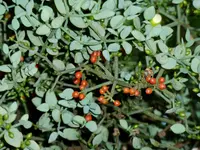
Redberry mistletoe, Viscum rotundifolium, is a perennial evergreen hemiparasite that grows attached to the branches of host trees and shrubs. It uses special structures called haustoria to draw water and nutrients while still performing its own photosynthesis.

This species forms dense, rounded clumps of small, rounded leaves and produces bright red berries that are highly attractive to birds. It is native to parts of southern Africa, where it occurs in dry woodland and savanna regions.

Its reliance on specific hosts makes it challenging to cultivate in typical home gardens, and it is rarely grown as a conventional potted plant. Gardeners who want to learn how to care for Redberry Mistletoe need to focus on choosing and maintaining a suitable host tree in compatible climates.

Main Plant Requirements

Care Difficulty

Hard Care

Light Preference

Partial Shade

Water Requirements

Low Water

Temperature Preference

Warm Climate

Hardiness Zone

10–12

Soil Texture

Sandy, Loamy, Rocky

Soil pH

Slightly acidic (6.5–7.0), Neutral (7.0)

Soil Drainage

Well-drained

Fertilization

Minimal (feed rarely)

Get Personalized Care Plan

Scan your plant to receive care tips personalized for your specific plant

Available on iOS and Android

How to Care for the Redberry Mistletoe

This hemiparasitic shrub prefers bright, gentle light that mimics open woodland edges.

  • Give Viscum rotundifolium 4–6 hours of bright, filtered light per day, such as dappled sun through a host tree canopy or light morning sun with afternoon shade.
  • Protect from harsh midday and late-afternoon sun; prolonged direct exposure in summer can scorch foliage and stress the host branch.
  • In winter, increased sun angle can still be intense, so maintain some light shade while ensuring the plant is not deeply shaded by dense evergreen cover.

Watering focuses on the host tree’s moisture, since the mistletoe taps into its tissues rather than soil.

  • Check the host tree’s root zone and water only when the top 5–8 cm of soil are dry, aiming for evenly moist but not saturated conditions around the host.
  • Signs of underwatering include widespread host leaf droop and dry, crumbly soil; persistent soggy soil, fungal growth, or dieback of fine twigs indicate overwatering stress.
  • For Viscum rotundifolium on drought-tolerant hosts, allow slightly deeper drying between waterings, and always prioritize free-draining soil to protect the host roots.

This species prefers mild, frost-free conditions typical of warm-temperate to subtropical regions.

  • Optimal growth occurs around 65–80°F (18–27°C) when attached to a healthy host in similar conditions, with steady temperatures supporting stable sap flow.
  • It tolerates brief drops to about 30–32°F (-1–0°C), but repeated or hard frosts can damage foliage and young shoots, especially on exposed outer branches.
  • In hot weather above 90°F (32°C), the plant copes better if the host tree has light shade and adequate moisture, reducing heat stress on both host and mistletoe.

This species tolerates a wide humidity range but benefits from moderately moist air.

  • Target 40–60% humidity, similar to most heated homes, for steady growth of Redberry Mistletoe.
  • Leaves curling inward or yellowing tips during hot, dry spells suggest humidity stress rather than watering issues.
  • Increase humidity by grouping host containers, placing them over a water-filled pebble tray, or lightly misting foliage during very dry weather.

Viscum rotundifolium is a hemiparasite, so container culture focuses on the host’s substrate rather than the mistletoe itself.

  • Use a light, airy mix such as 50% pine bark, 30% coarse sand, and 20% compost to keep the host roots well oxygenated.
  • Ensure rapid drainage; excess water around the host roots quickly reduces oxygen and weakens both host and mistletoe.
  • Aim for slightly acidic to neutral pH (6.0–7.0), avoiding highly alkaline mixes that limit nutrient availability.
  • Avoid dense clay-based mixes or fine peat that compact over time; add perlite or extra bark to improve structure and drainage.

This species can be grown in containers only when attached to a suitable potted host plant.

  • Choose a wide, heavy pot that resists tipping, since the combined host and mistletoe canopy can become uneven and top-heavy.
  • Select pot materials with moderate moisture retention, such as thick plastic or glazed clay, to avoid rapid drying of the host root zone.
  • Position the host stem so that the grafted or infected area remains well above the rim, keeping attachment sites dry and well aerated.

This hemiparasitic shrub usually gains enough nutrients from its host and generally does not need additional fertilization.

Pruning Viscum rotundifolium is mainly done to manage size and host tree health rather than to stimulate the mistletoe itself.

  • Carry out light pruning in late winter or early spring, before host tree growth starts.
  • Remove dead, damaged, or excessively dense clumps to improve air flow and light for the host branches.
  • Cut entire mistletoe tufts back to just above the host bark using clean, sharp bypass pruners.
  • Shape by thinning a few stems at their base instead of shearing, which reduces stress on both host and mistletoe.

This mistletoe is almost always grown on a living host branch, so transplanting focuses on host selection rather than container repotting.

  • Avoid transplanting established clumps, as removal from the host usually kills the plant.
  • If grown experimentally in containers on cut branches, replace the host material when decline, drying, or slow growth becomes obvious.
  • Time any experimental re-establishment for late winter to early spring, when host sap flow starts and attachment is more likely.
  • Handle host branches gently and keep them evenly moist to reduce stress while the mistletoe adjusts.

Propagation of Viscum rotundifolium relies on fresh seed rather than cuttings or division and is slow and uncertain.

  • Collect ripe berries and sow the sticky seeds immediately in late winter to early spring.
  • Press seeds gently onto young, healthy host twigs with intact bark, spacing them a few centimeters apart.
  • Maintain moderate humidity and avoid drying of the host twigs while seeds adhere and begin forming haustoria, the specialized feeding roots.
  • Expect germination and visible seedling growth to take many months, with only a fraction of seeds establishing successfully.

Established outdoor plants on hardy hosts usually cope well with typical mild to moderate winters and need little intervention.

  • In regions with frost, choose host trees suited to local winter lows to support long-term mistletoe survival.
  • For any container-grown experimental hosts, move pots indoors or into a frost-free, bright space when nights drop below 32°F.
  • Avoid heavy pruning or disturbance of attached clumps during the coldest months to minimize stress.

Care Tips

Select Healthy Hosts

When grafting onto a host shrub or tree, choose vigorous, disease-free branches about pencil thickness, as poor host health will directly limit mistletoe growth and berry production.

Controlled Grafting Points

Limit initial grafts to a few well-spaced points on the host canopy so the mistletoe does not overburden any single branch and you can monitor each infection site for success and host response.

Monitor Host Balance

Inspect the host annually and lightly thin excess mistletoe shoots if they begin to shade or weaken key structural branches, keeping a balance between host vigor and mistletoe growth.

Berry Handling Hygiene

When using ripe berries for propagation, wear disposable gloves or wash hands promptly afterward, and avoid touching tools or surfaces until the sticky viscin is removed to prevent accidental spread to unwanted host plants.

Weather-Smart Establishment

Time new grafting and seed placement for mild, frost-free periods with stable moisture so the haustoria, the specialized feeding roots, can establish before the plant faces heat, drought, or cold stress during caring for Redberry Mistletoe.

Common Pests and Diseases

Scale insects

This pest often settles along stems and leaf joints, where it sucks sap and weakens the plant, sometimes causing yellowing and dieback of affected segments.

Solution

Prune out heavily infested host twigs carrying the mistletoe, then gently scrape or wipe remaining scales from the mistletoe with a cotton pad dipped in diluted insecticidal soap or horticultural oil, repeating every 7–10 days until new growth appears clean.

Leaf-mining moth larvae

These insects tunnel within the succulent leaves, creating pale, winding trails and causing sections of the leaf to thin and discolor.

Solution

Remove and destroy mined leaves as soon as damage is seen to break the life cycle, and reduce nearby night lighting and dense surrounding foliage that shelter adult moths on the host tree to limit reinfestation when caring for Redberry Mistletoe.

Sooty mold

This disease develops as a black, powdery coating on leaves and stems, usually growing on the sticky honeydew left by sap-sucking insects such as scale or aphids.

Solution

Control the underlying honeydew-producing insects first, then gently wipe the mistletoe foliage with a damp cloth or rinse with a soft spray of water to remove the fungal coating and restore light exposure to the tissues.

Rust fungus

This disease causes yellow to orange spots or pustules on leaves and young stems, which can lead to premature leaf drop and reduced vigor.

Solution

Pinch off and discard infected leaves and small shoots, avoid overhead wetting from irrigation directed at the host tree, and keep the plant canopy better ventilated; in severe, recurring cases, a tree-care professional can evaluate targeted fungicide use on the host to reduce spore levels.

Interesting Facts

Southern African specialist

This mistletoe is native to southern Africa, where it typically parasitizes woody hosts such as acacias and other savanna trees rather than the broadleaf hosts more common in European mistletoes.

Distinct round leaves

The species name rotundifolium refers to its characteristically rounded, fleshy leaves, which reduce water loss and help it tolerate hot, dry savanna and shrubland climates.

Bird-dispersed berries

Its bright red berries are eaten by birds, which then deposit the sticky seeds onto new branches, allowing the parasite to establish fresh haustoria, the specialized structures that tap into the host’s water and nutrient supply.

Botan icon

Did you know?

In some southern African regions, different bird species show clear preferences for feeding on its berries, creating locally specialized dispersal networks that strongly shape where new plants can establish in the landscape.

FAQs about Redberry Mistletoe

This species can spread efficiently by bird-dispersed seeds but typically remains localized to suitable host branches. It does not usually smother large trees, though heavy infestations may stress weakened hosts over many years.

Grow Healthy Plants with Botan Care

Keep your plants happy and healthy with plant identification, disease detection, and easy care guidance.

Botan plant care app — identify plants on mobile

Explore More Plants