Two-wire training
Install a sturdy 2-wire trellis at about 90 cm and 180 cm high, then tie young shoots loosely to the lower wire and select 1–2 strong canes to form permanent trunks along the structure.

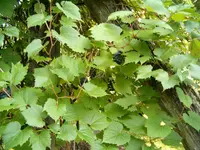
Riverbank grape, Vitis riparia, is a hardy, fast-growing deciduous vine native to North America. It often scrambles over shrubs and trees along rivers and woodland edges.
The plant has tendrils, lobed green leaves, and clusters of small fruits that turn dark blue to black when ripe. Birds and wildlife commonly feed on the berries.
This species tolerates cold climates and varied soils, which makes it relatively easy to establish in suitable outdoor spaces. Basic knowledge of how to care for riverbank grape helps manage its vigorous growth.
It generally prefers full sun to light shade, consistent moisture, and well-drained soil, especially when used for screens, arbors, or naturalized plantings.

Care Difficulty
Easy Care

Light Preference
Full Sun

Water Requirements
Regular Water

Temperature Preference
Cold Hardy

Hardiness Zone
3–8

Soil Texture
Sandy, Loamy, Clay

Soil pH
Acidic (5.5–6.5), Slightly acidic (6.5–7.0)

Soil Drainage
Moist but well-drained

Fertilization
Minimal (feed rarely)
Scan your plant to receive care tips personalized for your specific plant
Available on iOS and Android
This cold-hardy grape species thrives in full sun but can tolerate some shade, especially in hotter regions.
This vigorous vine prefers consistently moist but not saturated soil, especially while establishing.
This species is highly cold-tolerant and well adapted to temperate climates with distinct seasons.
This hardy grape tolerates a wide humidity range and seldom needs special humidity management outdoors.
Vitis riparia thrives in moist, well-drained, structured soils that balance water retention and aeration.
This vigorous, climbing species can be grown in containers only with careful support and root-space management.
This vigorous native vine usually grows well in average soil with modest feeding during the active season.
Pruning Vitis riparia manages its strong growth, improves air flow, and maintains structure.
This species is usually grown in the ground, so focus on transplanting young vines to a permanent site rather than frequent repotting.
Vitis riparia is commonly propagated for rootstock use and wildlife plantings using vegetative and seed methods.
This vine is very cold hardy and usually needs minimal winter care in the ground across most temperate regions.

Plant Health Check
Not sure what's wrong with your plant? Check your plant's health inside the app.
This species has been widely used as a rootstock for cultivated grapes because its roots tolerate cold soils and resist several important grape diseases, especially phylloxera, an insect pest that attacks grapevine roots.
Riverbank grape naturally grows in regions with harsh winters in North America and can withstand lower temperatures than most cultivated grapevines, contributing cold-hardiness traits to modern grape breeding.
In the wild, this vine is most often found along rivers, streams, and moist woodland edges, where its extensive root system helps stabilize banks and its dense growth provides cover and food for birds and other wildlife.

Genetic studies show that riverbank grape contributed significantly to the parentage of several cold-hardy hybrid wine and table grapes, making it an important wild ancestor behind many modern varieties used in cooler-climate viticulture.
This species spreads quickly by long vines and bird-dispersed seeds. In favorable conditions it can dominate fences, shrubs, and small trees. Regular pruning and monitoring are important to prevent it from overwhelming nearby plants and structures.
Keep your plants happy and healthy with plant identification, disease detection, and easy care guidance.