Bootlace Fern Care (Vittaria isoetifolia)

Also known as: Ribbon Fern
Bootlace Fern

About Bootlace Fern

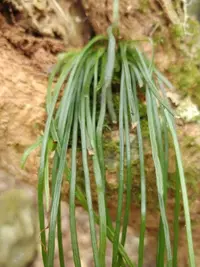
Bootlace fern, Vittaria isoetifolia, is a small epiphytic fern that often grows on tree trunks, rocks, or mossy walls in humid tropical and subtropical regions. It forms narrow, strap-like fronds that hang or drape, giving a fine, grass-like look rather than a typical feathery fern shape.

In nature it occurs across parts of Asia and the Pacific, usually in shaded, moist forest habitats with plenty of moving air. Its thin leaves and shallow roots dry out quickly, so consistent humidity and gentle moisture are important.

Because of this, care for Bootlace Fern is easier in terrariums, greenhouses, or bathrooms where stable humidity and soft, filtered light are available.

Main Plant Requirements

Care Difficulty

Hard Care

Light Preference

Partial Shade

Water Requirements

Keep Soil Moist

Temperature Preference

Tropical / Frost Sensitive

Hardiness Zone

11–12

Soil Texture

Peaty, Organic-rich, Loamy

Soil pH

Acidic (5.5–6.5)

Soil Drainage

Moist but well-drained

Fertilization

Minimal (feed rarely)

Get Personalized Care Plan

Scan your plant to receive care tips personalized for your specific plant

Available on iOS and Android

How to Care for the Bootlace Fern

This fern grows best in bright, filtered light that mimics a shaded forest canopy.

  • Provide 4–6 hours of bright, indirect light daily, such as light under a tree canopy or on a shaded patio with dappled sun.
  • Tolerates early morning sun but avoid harsh midday or afternoon sun, which can scorch the thin fronds of Bootlace Fern and cause bleaching.
  • In deeper shade, growth becomes sparse and fronds elongate toward light, so gradually increase exposure using sheer shade cloth or a brighter position.

This species prefers consistently moist conditions without waterlogging the roots or mounting surface.

  • Water when the surface and upper 2–3 cm of the substrate feel just barely damp, not dry or soggy, using gentle, thorough soaking.
  • In warm months, expect to water more often as moisture evaporates faster; in cooler seasons, allow slightly more time between waterings while never letting it fully dry.
  • Signs of overwatering include black, mushy rhizomes and sour smell; underwatered Vittaria isoetifolia shows crisp, browning frond tips and curling blades.

This fern prefers warm, stable temperatures similar to a humid, tropical understory.

  • Optimal growth occurs around 65–80°F (18–27°C), with steady warmth and high humidity supporting healthy, flexible fronds.
  • Avoid temperatures below 55°F (13°C); brief dips to 45–50°F (7–10°C) may be survived but can slow growth and damage tender tissue.
  • This plant does not tolerate frost and suffers in extreme heat above 90°F (32°C), so provide shade and extra humidity during hot spells and protect from cold snaps.

This species needs consistently humid air to maintain healthy fronds.

  • Aim for 60–80% humidity, as Bootlace Fern comes from moist forest habitats.
  • Crisping or curling frond tips and stalled new growth indicate air is too dry.
  • Use a nearby humidifier, pebble tray under the pot, or group plants to raise local humidity.

This fern prefers a loose, airy, organic-rich medium rather than typical dense potting soil.

  • Use a mix such as 50% fine bark, 30% peat or coco coir, and 20% perlite for strong aeration.
  • Ensure very fast drainage, as roots should stay evenly moist but never sit in stagnant water.
  • A slightly acidic pH around 5.5–6.5 supports nutrient uptake for Vittaria isoetifolia.
  • Avoid heavy clay-based mixes or compacted substrates that limit oxygen around the roots.

This species is well suited to container culture, especially in hanging pots or mounted planters.

  • Choose a shallow but wide container to accommodate its spreading root system and strap-like fronds.
  • Select a pot with multiple small drainage holes to let water exit quickly without losing the airy mix.
  • Use a lightweight plastic or slatted basket to maintain moisture while still allowing high airflow around the roots.

This fern grows on minimal nutrients but accepts light feeding under cultivation to support steady growth.

  • Use a very dilute balanced liquid fertilizer (around 1/4 strength) or organic compost extract suitable for epiphytes.
  • Feed every 4–6 weeks during spring and summer only, when growth is active.
  • Avoid slow-release pellets packed around roots, which can burn this fine-rooted epiphyte.
  • Stop feeding in fall and winter, when Bootlace Fern growth naturally slows and nutrient demand drops.

Pruning for Vittaria isoetifolia is light and focuses on cleanliness rather than shaping.

  • Carry out tidying in late winter or early spring, before new fronds extend.
  • Snip off dead, yellow, or damaged fronds at the base to reduce disease risk and improve airflow.
  • Thin out badly tangled or overcrowded fronds to show the natural strap-like form.
  • Use clean, sharp scissors or small snips and avoid cutting healthy green tissue unnecessarily.

Repotting or transplanting this epiphytic fern is infrequent and should be done gently to protect its fine roots.

  • Look for roots circling a mount, basket, or pot, rapid drying, or slowed growth as signs it needs more space.
  • Plan to move it only every 2–3 years, ideally in spring when conditions favor recovery.
  • Shift into a slightly larger container or mount with a loose, airy medium such as fine bark and sphagnum.
  • Handle roots carefully, keep them just moist, and shade the plant for 1–2 weeks to reduce transplant stress.

Propagation of Vittaria isoetifolia is possible but slow and usually done by advanced growers rather than beginners.

  • Spore propagation is the main method; spores form on the undersides of mature fronds.
  • Collect spores in late summer, then sow on sterile, consistently moist, fine-textured medium.
  • Maintain very high humidity, stable warmth around 70–75°F, and low to medium light for germination.
  • Avoid disturbing the delicate prothalli and young plantlets until they form several small strap-like fronds.

Winter care focuses on keeping this tropical fern above freezing and in stable, humid conditions.

  • Treat it as frost sensitive; avoid exposure below 40°F and especially any freeze.
  • Move container plants indoors or into a heated greenhouse before night temperatures drop in fall.
  • Provide bright, indirect light, 50–70°F temperatures, and 50–70% humidity during winter months.
  • Reduce watering slightly in cooler conditions, keeping the medium just barely moist, not wet.

Care Tips

Mounting Technique

Grow this fern mounted on cork bark or hardwood with a thin layer of long-fiber sphagnum moss around the roots, then secure it gently with soft ties or nylon fishing line so the narrow fronds can hang naturally and dry quickly after watering.

Airflow Management

Place the plant where there is gentle, constant air movement from a small fan or open vent, which helps prevent fungal issues on the fine fronds without causing rapid drying of the root zone.

Watering Setup

Use a narrow-spout bottle or squeeze bottle to direct water only to the moss-covered root pad, keeping the fronds and mounting surface from staying wet for long periods and reducing rot risk.

Salt Build‑Up Control

Every 4–6 weeks, flush the mount thoroughly with low-mineral water until it runs freely from the base, which removes accumulated fertilizer salts that can burn the delicate root system.

Placement Rotation

Rotate the mount a quarter turn every 2–3 weeks and tilt it slightly if needed so the hanging fronds develop evenly and do not crowd or mat against nearby surfaces when caring for Bootlace Fern.

Common Pests and Diseases

Scale insects

This pest attaches to the narrow strap-like fronds and rhizomes, sucking sap and causing yellowing, thinning, and weak growth. Symptoms include small brown or tan bumps that do not rub off easily.

Solution

Isolate the plant, then gently wipe fronds and exposed rhizomes with cotton pads dipped in 70% isopropyl alcohol or insecticidal soap, taking care not to bend the fronds sharply. Repeat every 7–10 days until no new scale appears and improve air movement and humidity stability to reduce stress while caring for Bootlace Fern.

Mealybugs

These insects hide in crevices along the wiry rhizomes and at frond bases, leaving cottony white clusters and sticky honeydew. Symptoms include stunted new fronds and occasional sooty mold growth on affected areas.

Solution

Remove visible clusters with a cotton swab dipped in 70% isopropyl alcohol, then rinse the plant under a gentle, lukewarm shower to dislodge remaining insects. Repeat spot treatments weekly and lightly mist or spray with insecticidal soap, keeping the fine fronds supported to avoid mechanical damage.

Rhizoctonia leaf blight

This disease affects crowded, humid-grown plants, producing brown, irregular lesions that start at frond bases and can cause whole fronds to collapse. Symptoms include webby fungal growth on the media surface or rhizomes in very moist, stagnant conditions.

Solution

Trim and discard all affected fronds, avoid overhead watering, and let the surface of the substrate dry slightly between waterings while maintaining overall humidity. Increase airflow around the plant and, if spread continues, repot into fresh, well-drained epiphytic mix and drench with a labeled fern-safe fungicide following instructions carefully.

Bacterial leaf spot

This disease causes small, water-soaked translucent spots along the narrow fronds that enlarge, turn dark, and may coalesce, making fronds look tattered. Symptoms include faster development in warm, wet conditions with frequent misting on the foliage.

Solution

Remove and discard affected fronds promptly and avoid wetting the foliage, directing water only to the substrate or mounting surface. Improve air circulation, reduce overcrowding, and keep humidity stable rather than relying on frequent heavy misting; in severe cases, start fresh divisions from symptom-free rhizome tips and discard the heavily affected plant section.

Interesting Facts

Strap-like fertile leaves

This fern produces extremely narrow, strap-like fronds that can be under 2 mm wide, with sporangia (spore-bearing structures) arranged in long continuous lines along the frond margins rather than in discrete clusters.

Epiphyte of humid forests

It typically grows as an epiphyte on tree trunks and branches in moist, shaded tropical forests, using bark only as a support and taking up water and nutrients from rain, mist, and organic debris.

Minimal root system

The plant has a very reduced root system attached to a creeping rhizome, reflecting its adaptation to life on tree bark where anchorage is more important than deep soil exploration.

Botan icon

Did you know?

This species is part of a group sometimes called shoestring or bootlace ferns because mature plants can form long, hanging curtains of threadlike fronds draped over tree branches in humid forest canopies.

FAQs about Bootlace Fern

Growth is generally slow to moderate. New strap-like fronds appear gradually, and it can take 2–3 years to form a dense clump. Limited root mass and epiphytic habit naturally restrict rapid expansion, especially in containers.

Grow Healthy Plants with Botan Care

Keep your plants happy and healthy with plant identification, disease detection, and easy care guidance.

Botan plant care app — identify plants on mobile

Explore More Plants