Florida mudmidget Care (Wolffiella gladiata)

Also known as: sword bogmat

About Florida mudmidget

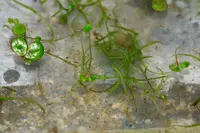
Florida mudmidget (Wolffiella gladiata) is a tiny, free-floating aquatic plant in the duckweed family. It forms smooth, ribbonlike strands that drift just below the water surface, with no visible leaves or stems.

This species occurs naturally in calm, shallow waters of the southeastern United States, especially in ponds, ditches, and slow-moving wetlands. It spreads quickly under stable, nutrient-rich conditions, which makes it useful for water polishing but also able to cover surfaces fast.

Light to moderate shade, still water, and consistent moisture support healthy growth. Understanding these traits helps plant keepers learn how to care for Florida mudmidget in aquaria, tubs, or outdoor water features.

Main Plant Requirements

Care Difficulty

Moderate Care

Light Preference

Partial Shade

Water Requirements

Aquatic

Temperature Preference

Tropical / Frost Sensitive

Hardiness Zone

8–11

Soil Texture

Silty, Organic-rich

Soil pH

Slightly acidic (6.5–7.0), Neutral (7.0)

Soil Drainage

Waterlogged tolerant

Fertilization

Minimal (feed rarely)

Get Personalized Care Plan

Scan your plant to receive care tips personalized for your specific plant

Available on iOS and Android

How to Care for the Florida mudmidget

This tiny floating aquatic plant needs bright, indirect light to maintain compact, healthy growth.

  • Provide 4–6 hours of bright, filtered light per day, such as morning sun with dappled shade or light cloud cover at midday.
  • Tolerates partial shade (2–4 hours of sun), but growth slows and colonies thin if light stays low for many days; Florida mudmidget then becomes pale green or yellowish.
  • Avoid intense, direct afternoon sun in shallow water, which can overheat the surface and scorch tissue; use taller marginal plants or shade cloth in summer if water exceeds 80°F (27°C).

As a free-floating species, this plant depends completely on stable, clean water conditions rather than soil moisture.

  • Maintain a consistently flooded environment 10–40 cm deep, with gentle or still water; do not allow the habitat to dry down, even briefly.
  • Good water quality is essential for Wolffiella gladiata; cloudy water, strong odors, or algae blooms indicate excess nutrients and low oxygen that can stunt or kill fronds.
  • Signs of stress from poor hydration conditions include shrinking mats, browning edges, or rapid die-off, often linked to drying margins, drastic level changes, or contaminated runoff.

Stable warmth supports fast growth and recovery in this delicate floating plant.

  • Aim for 70–82°F (21–28°C) for sustained growth; development slows below 68°F (20°C) and very rapid spread occurs near the upper end of this range if nutrients are sufficient.
  • Avoid temperatures below 50°F (10°C); brief dips to 45–50°F (7–10°C) may be survived but repeated cold exposure leads to tissue collapse and population loss.
  • The plant tolerates short heat spikes to about 90°F (32°C) if water remains well-oxygenated and not stagnant; provide partial shade and water movement during hot summer periods to limit overheating.

This free-floating aquatic species requires constant, very high humidity because its fronds sit directly on the water surface.

  • Target 80–100% humidity by keeping plants on open water surfaces or in covered aquatic trays.
  • Dry air causes fronds to desiccate, curl, lose buoyancy, and show pale or brown edges.
  • Increase humidity by using closed aquaria, covered tubs, or greenhouse benches rather than exposed, evaporative setups when caring for Florida mudmidget.

This plant does not root in soil and instead floats freely on still or slow-moving water.

  • Grow Wolffiella gladiata in shallow trays, tubs, or ponds with 5–20 cm of water over any inert base such as washed sand or bare liner.
  • Use nutrient-rich water (aquatic fertilizer at very low doses or fish waste) rather than potting mixes, since fronds absorb nutrients directly from the water column.
  • Maintain neutral to slightly acidic water (pH 6.0–7.2) and avoid highly alkaline or hard water that can limit nutrient availability.
  • Prevent organic sludge buildup at the bottom, which reduces oxygen and can lead to rot; periodically remove decaying leaves and excess debris.

This species grows well in containers when treated as a floating aquatic mat rather than a rooted potted plant.

  • Choose wide, shallow containers to maximize surface area for frond spread and light exposure across the water surface.
  • Use rigid, stable tubs or trays so the waterline stays level and the floating mat is not disturbed by flexing walls.
  • Avoid porous materials that seep or wick water away, as fluctuating water levels quickly stress the floating plants.

This tiny floating aquatic plant needs only light feeding in controlled culture, since it absorbs nutrients directly from the water.

  • Use a dilute balanced NPK aquatic fertilizer at 1/4–1/2 strength to avoid burning tissue.
  • Feed every 2–4 weeks during active warm-season growth when caring for Florida mudmidget.
  • Reduce or stop fertilization in cooler months when growth slows, especially outdoors.
  • Monitor water quality; avoid overfeeding, which encourages algae and depletes oxygen.

Pruning Wolffiella gladiata is mainly about managing surface coverage and maintaining healthy growth in ponds or aquaria.

  • Thin mats during peak growth, ideally in warm seasons, to keep light reaching all fronds.
  • Scoop out dead, yellowing, or damaged plants with a fine net to limit decay in the water.
  • Remove crowded patches to direct resources to young, vigorous fronds and stabilize population density.
  • Use clean nets or siphon hoses and avoid crushing plants, which can foul the water.

This free-floating aquatic is not conventionally repotted but can be transplanted by relocating small portions between containers or ponds.

  • Transplant when growth is dense or overcrowded, or when establishing a new water feature or culture tank.
  • Move clumps in late spring or early summer when water is warm and growth is strongest.
  • Transfer plants with a cup or fine net, keeping roots submerged at all times to limit stress.
  • Acclimate to new water by mixing small amounts of the new water into the old culture over 15–30 minutes.

Wolffiella gladiata is commonly propagated by vegetative division as its tiny flowers and seeds are rarely used in home culture.

  • Rely on natural fragmentation, where small clusters break off and form new colonies.
  • For controlled propagation, gently separate healthy clumps and spread them over the surface of a nutrient-rich, still-water container.
  • Carry out division in late spring or summer when light and temperature are favorable for rapid growth.
  • Maintain stable warm water, gentle circulation, and good water quality to support continuous vegetative spread.

This warm-climate aquatic species is frost sensitive and needs protection in regions with cold winters.

  • In zones with frost risk, move container-grown cultures indoors before temperatures drop below 50°F.
  • Provide an indoor aquarium or tub with stable, unfrozen water and moderate lighting.
  • In mild climates, maintain at least part of the population in a protected tank as backup stock.
  • Avoid allowing ponds to freeze solid; even thin ice can damage these delicate floating plants.

Care Tips

Containment Netting

Use a fine-mesh floating ring or net to confine the plant to part of the water surface, which simplifies harvesting, prevents it from clogging filters, and keeps an open area for gas exchange.

Staggered Harvesting

Skim off only 20–40% of the mat at a time every few days instead of doing a complete cleanout, which maintains a stable population and reduces shock to the aquatic ecosystem.

Surface Agitation Control

Limit strong surface agitation and direct filter outflows by redirecting them downward or against tank walls so the delicate fronds are not constantly pushed, torn, or submerged.

Nutrient Monitoring

Test water regularly for nitrate and phosphate and top up nutrients gradually if growth slows despite good light, since thin, pale fronds often indicate depletion rather than disease.

Quarantine New Stock

Quarantine new plant material in a separate container for 7–10 days to check for snails, duckweed, algae, or pathogens before introducing it to a main tank when growing Florida mudmidget.

Common Pests and Diseases

Algal overgrowth

This issue appears as dense green film or cloudy water that shades and competes with the floating fronds. Symptoms include slowed growth and thinning mats of plants at the water surface.

Solution

Limit nutrient inputs, especially excess fish food or fertilizer, and increase partial water changes to reduce dissolved nutrients. Provide gentle water movement, manually skim excess algae from the surface, and, if possible, shade part of the container to reduce intense direct sun while monitoring that Wolffiella gladiata still receives enough light.

Duckweed weevils

These insects feed on fronds and can cause small holes, browning, and rapid thinning of the floating mat. This pest is more common in outdoor ponds or tubs where wild duckweed relatives grow nearby.

Solution

Skim and discard heavily damaged plant material, then flush the container or pond with a partial water change to remove larvae. Use fine mesh screening to limit adult beetle access, and if infestation persists, move a clean portion of the plant to a new container for Florida mudmidget indoor care away from outdoor water sources.

Water mites

These pests are tiny arachnids that crawl on or around the floating plants, sometimes causing frond discoloration, reduced vigor, or patchy dieback. Symptoms include seemingly unexplained decline even when water chemistry appears acceptable.

Solution

Rinse plants gently in clean, conditioned water through a fine net to dislodge mites, repeating every few days. Improve water quality with regular small water changes, avoid overcrowding of plants, and, if needed, temporarily isolate a healthy portion of the colony in fresh water to reestablish a clean culture.

Bacterial soft rot

This disease causes fronds to become translucent, slimy, and foul-smelling, often leading to rapid break‑up of the floating mat. Symptoms include cloudy water and decaying plant tissue that disintegrates when touched.

Solution

Remove and discard all soft, decomposing material and perform a substantial water change to lower bacterial load. Maintain cooler, stable water temperatures, avoid overfeeding fish or adding high nutrient loads, and restart the culture with only firm, healthy-looking fronds in clean, well-aerated water.

Filamentous fungus

This disease shows as fine white or gray cottony threads on decaying fronds or plant debris, especially in still, nutrient-rich water. Symptoms include localized dieback starting where fungal growth is most visible.

Solution

Physically remove all visibly affected plant matter and any trapped organic debris, then increase water circulation and schedule more frequent small water changes. Reduce organic buildup by avoiding overfeeding fish and promptly removing dead plant material so healthy fronds can regrow without fungal pressure.

Interesting Facts

One of the smallest angiosperms

This species is among the tiniest flowering plants on Earth, with each flattened, leafless body often less than 2 mm long yet still producing highly reduced flowers under the water surface.

Ribbonlike, rootless body

The plant forms narrow, ribbonlike fronds that float just below the water surface and lack true roots, absorbing nutrients directly from the surrounding water instead.

Patch-forming surface carpet

In calm, nutrient-rich, shallow waters of the southeastern United States, this species often forms dense, free-floating mats that can quickly cover small ponds and ditches, strongly influencing light penetration and temperature at the water surface.

FAQs about Florida mudmidget

This floating species spreads very quickly by fragmentation. In nutrient-rich, still or slow-moving water it can form dense surface mats. Regular thinning and physical removal are usually needed to prevent it from covering the entire water surface.

Grow Healthy Plants with Botan Care

Keep your plants happy and healthy with plant identification, disease detection, and easy care guidance.

Botan plant care app — identify plants on mobile

Explore More Plants